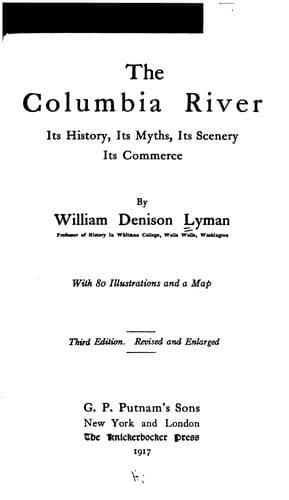
The Columbia River: Its History, Its Myths, Its Scenery, Its CommerceLyman, William Denison
History
The Columbia River: Its History, Its Myths, Its Scenery, Its Commerce
Lyman, William Denison
Columbia River; Columbia River -- Description and travel; Columbia River -- History
so fascinating a bit of narration that it ought to be true. Two hundred
years later John Meares, the English navigator, attached the name of the
stout old Greek pilot to that inlet now familiar to ships of all nations.
With the passage of a few years more, explorations upon the western shore
of America began to assume a more definite form. In 1602 the best equipped
squadron thus far sent out left Acapulco under command of Vizcaino, with
the aim of carrying out Monterey's great purpose for the northward
extension of Spanish power. The fleet being scattered by storm, the
_fragata_ in command of Martin Aguilar ran up the coast as far as latitude
43 degrees. There they found a cape to which they attached the name still
held, Cape Blanco. From that point, following the north-westerly trending
of the coast, they soon came abreast of a "rapid and abundant river, with
ash trees, willows, and brambles, and other trees of Castile upon its
banks." This they endeavoured to enter, but from the strength of the
current could not. "And seeing that they had already reached a higher
latitude than had been ordered by the viceroy and that the number of the
sick was great, they decided to return to Acapulco." Torquemada, the
historian, from whom the account is taken, goes on to say:
It is supposed that this river is one leading to a great city, which
was discovered by the Dutch when they were driven thither by storms,
and that it is the Strait of Anian, through which the vessels passed
in sailing from the North Sea to the South Sea; and that the city
called Quivera is in those parts; and that this is the region referred
to in the account which His Majesty read, and which induced him to
order this expedition.
The interesting question arises, Was the river the Columbia? It is the
only large river on the Oregon coast, though the Umpqua, if at flood
stage, might have given the impression of size. The latitude is not right,
either, though the Spanish narrator does not say how far north of Cape
Blanco they went. But whether or not Aguilar really went so far north as
the Columbia, his voyage was one of much interest. It gave Spain a warrant
to claim the western coast of America; it still further strengthened the
idea of the Strait of Anian; it seemed to confirm the romantic conception
of a great city or group of cities with civilised inhabitants along that
passage way, and it gave the first name to the river, the Rio de Aguilar.
Thenceforth the navigators of all nations accepted as the primary object
of their search some great river of the West. Hidden in the fogs of fancy,
as it lay shrouded in truth in the mists of the ocean, the supposed Rio
de Aguilar yet held the spell of enchantment over many an "ancient
mariner" of many a land. Whatsoever nation could actually find the river
and establish a definite claim to first discovery, would have, by the
generally accepted usage of nations, the right of occupation and
ownership.
Public-domain text, read in full here on John Shaqi.
Reviews
Reviews
No reviews yet
Be the first to share your thoughts on this work.
Join the Discussion
Join the discussion
Sign in to leave a comment or review.
Sign InorCreate an account