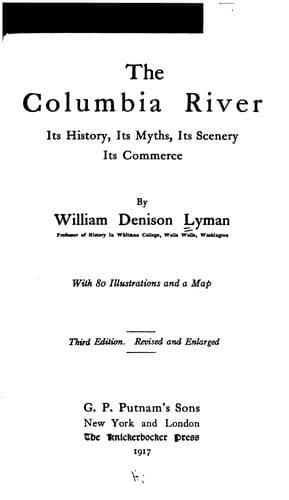
The Columbia River: Its History, Its Myths, Its Scenery, Its CommerceLyman, William Denison
History
The Columbia River: Its History, Its Myths, Its Scenery, Its Commerce
Lyman, William Denison
Columbia River; Columbia River -- Description and travel; Columbia River -- History
But just at that important juncture a most favouring condition arose for
Spain. The government of England precipitated the struggle of the American
Revolution. France soon joined to strike her island rival a deadly blow by
assisting in the liberation of the colonies. For the time, Spain had
nearly a clear field for Pacific discovery, so far as England and France
were concerned. As for Russia, the danger was more imminent. Russia had,
indeed, begun to look in the direction of Pacific expansion a long time
prior to the Spanish immigration to California. That vast monarchy,
transformed by the genius of Peter the Great, had stretched its arms from
the Baltic to the Aleutian Archipelago, and had looked from the frozen
seas of Siberia to the open Pacific as a fairer field for expansion. Many
years elapsed, however, before Peter's great designs could be fulfilled.
Not till 1741 did Vitus Behring thread the thousand islands of Sitka and
gaze upon the glaciated crest of Mt. St. Elias. And it was not till thirty
years later that it became understood that the Bay of Avatcha was
connected by the open sea with China. In 1771 the first cargo of furs was
shipped directly from Avatcha to Canton. Then first the vastness of the
Pacific Ocean was comprehended. Then first it was understood that the same
waters which lashed the frozen ramparts of Kamchatka encircled the coral
islands of the South Sea and roared against the stormy barriers of Cape
Horn.
The Russians had not found the Great River, though it appears that Behring
in 1771 had gone as far south as latitude 46 degrees, just the parallel of
the mouth of the Columbia. But he was so far off the coast as not to see
it.
Three Spanish voyages followed in rapid succession: that of Perez in 1774,
of Heceta in 1775, and of Bodega in 1779. The only notable things in
connection with the voyage of Perez were his discovery of Queen
Charlotte's Island, with the sea-otter furs traded by the natives, the
first sight of that superb group of mountains which we now call the
Olympic, but which the Spaniards named the Sierra de Santa Rosalia, and
finally the fine harbour of Nootka on Vancouver Island, named by Perez
Port San Lorenzo, for years the centre of the fur-trade and the general
rendezvous of ships of all nations. But no river was found.
Public-domain text, read in full here on John Shaqi.
Reviews
Reviews
No reviews yet
Be the first to share your thoughts on this work.
Join the Discussion
Join the discussion
Sign in to leave a comment or review.
Sign InorCreate an account