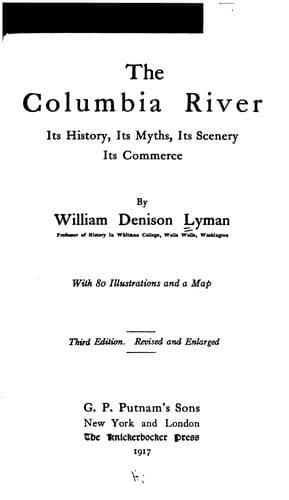
The Columbia River: Its History, Its Myths, Its Scenery, Its CommerceLyman, William Denison
History
The Columbia River: Its History, Its Myths, Its Scenery, Its Commerce
Lyman, William Denison
Columbia River; Columbia River -- Description and travel; Columbia River -- History
On the twelfth day of August, an advance party of the explorers crossed
the Great Divide of the Rocky Mountains, the birthplace of mighty rivers.
Descending the western slope, they found themselves in the country of the
Shoshone Indians. Captain Lewis was leading this advance expedition, and,
as he neared the highest point of the pass, he realised the significance
of the transition from the waters of the Missouri to those of the
Columbia. A quotation from his narrative at this most interesting point of
the journey gives the reader a better conception than any description
could, of the feelings of the explorers:
The road was still plain, and as it led directly toward the mountains,
the stream gradually became smaller, till after their advancing two
miles further, it had so greatly diminished in width that one of the
men in a fit of enthusiasm, with one foot on each side of the rivulet,
thanked God that he had lived to bestride the Missouri. As they
proceeded, their hope of seeing the waters of the Columbia rose to
almost painful anxiety; when at the distance of four miles from the
last abrupt turn of the stream, they reached a small gap formed by the
high mountains which recede on either side, leaving room for the
Indian road. From the foot of one of the lowest of these mountains,
which arises with a gentle ascent of about half a mile, issued the
remotest water of the Missouri. They had now reached the hidden
sources of that river, which had never before been seen by civilised
man; and as they quenched their thirst at the chaste and icy
fountain,--as they sat down by the brink of that little rivulet, which
yielded its distant and modest tribute to the parent ocean,--they felt
themselves rewarded for all their labours and difficulties. They left
reluctantly this interesting spot, and pursuing the Indian road
through the interval of the hills, arrived at the top of a ridge from
which they saw high mountains, partially covered with snow, still to
the west of them. The ridge on which they stood formed the dividing
line between the waters of the Atlantic and the Pacific Oceans. They
found the descent much steeper than on the eastern side, and at the
distance of three-quarters of a mile, reached a handsome, bold creek
of cold, clear water running to the westward. They stopped to taste
for the first time the waters of the Columbia.
The party was now upon the western slope of the Great Divide, in the
vicinity of the present Fort Lemhi in Eastern Idaho. They supposed that
they were almost to the Pacific, not realising that a thousand miles of
difficult and dangerous travel and more than two months of time still
separated them from their wished-for goal. The journey, in fact, from the
springs of the Missouri to the navigable waters of the Columbia, proved to
be the most critical of the whole series.
Public-domain text, read in full here on John Shaqi.
Reviews
Reviews
No reviews yet
Be the first to share your thoughts on this work.
Elsewhere in the archive
Join the Discussion
Join the discussion
Sign in to leave a comment or review.
Sign InorCreate an account