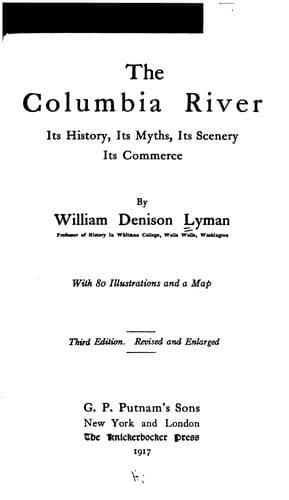
The Columbia River: Its History, Its Myths, Its Scenery, Its CommerceLyman, William Denison
History
The Columbia River: Its History, Its Myths, Its Scenery, Its Commerce
Lyman, William Denison
Columbia River; Columbia River -- Description and travel; Columbia River -- History
They were at this time among some of the upper branches of the second
largest tributary of the Columbia, named by them Clark's Fork, though at
the present time more commonly known by the more rhythmic title of Pend
Oreille. After several days of the most difficult, and indeed dangerous,
journeying of their entire trip, they abandoned the northern route, turned
southward, and soon reached the wild and beautiful stream which they
called the Kooskooskie, commonly known to modern times as the Clearwater,
one of the finest of all the fine rivers of Idaho, the "Gem of the
Mountains."
But they were not yet by any means clear of danger. The country still
frowned on them with the same forbidding crags, and the same blinding snow
storms as before. They were approaching the starvation point. The craggy
precipices were marked with almost daily accidents to men and beasts.
Their only food was the flesh of their precious horses. Under these
harassing circumstances, it was decided that the wisest thing was for
Captain Clark to take six of his best men and press rapidly forward in
search of game and a more favourable country. After a hard journey of
twenty miles, he found himself upon the crest of a towering cliff, from
which stretched in front a vast open plain. This was the great plain, now
covered with wheat-fields and orchards, lying east and north of the
present city of Lewiston, Idaho. Having made their way down the
declivities of the Bitter Root Mountains to the prairie, where they found
a climate that seemed almost tropical after the bitter cold of the high
mountains, the advance guard camped and waited for the main party to come
up.
Rejoicing at their release from the distressing conditions of their
passage of the Bitter Root Mountains, they passed onward to a beautiful
mountain-enclosed valley, which must have been in the near vicinity of
what is known as the Kamiah Valley of the present time. Here they found
themselves with a large body of Indians who became known subsequently as
the Nez Perces. These Indians appeared to be the most honest, intelligent,
and attractive they had yet met,--eager to assist them, kind and helpful,
although shrewd and business-like in their trading.
The Nez Perces imparted to them the joyful news that the Great River was
not far distant. Seeing the Clearwater to be a fine, navigable stream, the
explorers determined to abandon the weary land journey and once more
commit their fortunes to the waters. They left their horses with the Nez
Perces, asking that they should meet them at that point in the following
spring when they expected to be on their return trip. The scrupulous
fidelity with which the Nez Perces carried out their trust is some
evidence of the oft-made assertion that the treachery characteristic of
the Indians was learned afterwards from the whites.
Public-domain text, read in full here on John Shaqi.
Reviews
Reviews
No reviews yet
Be the first to share your thoughts on this work.
Elsewhere in the archive
Join the Discussion
Join the discussion
Sign in to leave a comment or review.
Sign InorCreate an account