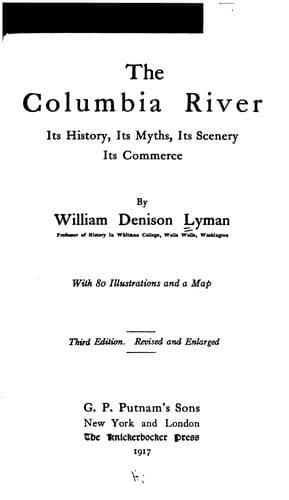
The Columbia River: Its History, Its Myths, Its Scenery, Its CommerceLyman, William Denison
History
The Columbia River: Its History, Its Myths, Its Scenery, Its Commerce
Lyman, William Denison
Columbia River; Columbia River -- Description and travel; Columbia River -- History
For another fortnight, the cold and hungry party floundered painfully
through the snow across the rugged mountains which lie between what we now
know as the Powder River Valley and the Grande Ronde. Reaching a lofty
mountain height on the last day of December, they looked far down into a
fair and snowless prairie, bathed in sunshine and appearing to the
winter-worn travellers like a gleam of summer. Moreover, they soon
discerned a group of Indian lodges which they judged were well supplied
with dogs and horses. Thither hastening eagerly, they soon found
themselves in a beautiful valley, which from their description must have
been the Grande Ronde Valley. Beautiful at all times, it must have seemed
trebly so to these ragged and famished wanderers.
The next morning the new year of 1812 shone in upon them bright and
cheerful, as if to make amends for the stern severity of the outgoing
year. And now the Canadians insisted upon having their New Year's holiday.
Not even death and famine could rob the light-hearted _voyageurs_ of their
festivals. So with dance and song and with dog meat, roasted, boiled,
fried, and fricasseed, they met the newly-crowned year with their Gallic
happiness and abandon.
The Indians assured them that they could reach the Great River within
three days. But they found it twice that, and their way led across another
lofty chain of snowy mountains, before the canopy of clouds which hung
above them parted. There, looking far down from their snowy eyre, they
beheld the boundless and sunny plains of the Great River. Swiftly
descending the slopes of the mountains, they emerged upon that finest land
of all Eastern Oregon, the plains of the Umatilla. Here they found the
tribe of the Tushepaw Indians with thirty-four lodges and two hundred
horses. More significant than these to Hunt were axes, kettles, and other
implements of white construction, indicating that these Indians had
already come into communication with the traders upon the lower River. In
answer to his eager questions, the Tushepaws informed him that the Great
River was but two days distant and that a small party of white men had
just descended it. Being now certain that this was the advance guard which
had left him at the Devil's Scuttle-hole, Hunt felt sure that they were
safe and was therefore relieved of one great anxiety.
Public-domain text, read in full here on John Shaqi.
Reviews
Reviews
No reviews yet
Be the first to share your thoughts on this work.
Elsewhere in the archive
Join the Discussion
Join the discussion
Sign in to leave a comment or review.
Sign InorCreate an account