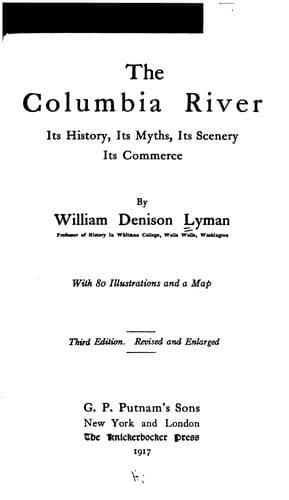
The Columbia River: Its History, Its Myths, Its Scenery, Its CommerceLyman, William Denison
History
The Columbia River: Its History, Its Myths, Its Scenery, Its Commerce
Lyman, William Denison
Columbia River; Columbia River -- Description and travel; Columbia River -- History
As we have seen, they had lost several of their number from starvation and
drowning along the banks of the Snake River. They had also left six sick
men with the Indians in the heart of the mountains. They had little hope
of ever seeing these again, but the next summer the party on their way up
the Columbia River, saw two wretched looking beings, naked and haggard,
wandering on the river bank near the mouth of the Umatilla. Stopping to
investigate, they discovered that these were Day and Crooks, the leaders
of the party which they had left behind. Their forlorn plight was relieved
with food and clothes, and, having been taken into the boat, they related
their dismal tale. It appeared that they had been provided sufficiently by
the Indians to sustain their lives through the winter. In the spring they
had left the Canadians among the Indians, and had set forth in the hope of
reaching the Great River. But having reached The Dalles, they had been
robbed of rifles and ammunition, stripped of their clothing, and driven
forth into the wilderness. They were almost at the point of a final
surrender to ill-fortune when they beheld the rescuing boat. So, with
joyful hearts, they turned their boat's prow to Astoria, which they
reached in safety. But poor Day never regained his health. His mind was
shattered by the hardships of his journey, and he soon pined away and
died. The barren and rugged shores of the John Day River in Eastern Oregon
take on an added interest in view of the sad story of the brave hunter who
discovered them, and who wandered in destitution for so many days beside
them. Strange to say, the four Canadians who remained among the Indians
were afterwards found alive, though utterly destitute of all things. Hence
it appears that the loss of life in this difficult journey was not great.
The journeys here narrated may be considered as covering what we have
designated as the first steps across the wilderness. Within a few years,
many parties of trappers, explorers, and adventurers, with some
scientists, and a little later, parties of missionaries, made their way
over the great plains, through the defiles of the mountains, and down the
barren shores of the Snake River to the Columbia and the sea. Each party
had its special experiences, and made its special contribution to
geographical or commercial advancement. But to the parties led by Lewis
and Clark and by Hunt, we must accord the greatest meed of praise for
having broken the first pathways across the continent and for having
linked the two oceans by the footsteps of civilised men.
CHAPTER V
The Fur-Traders, their Bateaux, and their Stations
Public-domain text, read in full here on John Shaqi.
Reviews
Reviews
No reviews yet
Be the first to share your thoughts on this work.
Elsewhere in the archive
Join the Discussion
Join the discussion
Sign in to leave a comment or review.
Sign InorCreate an account