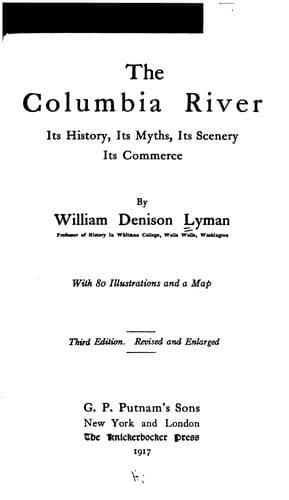
The Columbia River: Its History, Its Myths, Its Scenery, Its CommerceLyman, William Denison
History
The Columbia River: Its History, Its Myths, Its Scenery, Its Commerce
Lyman, William Denison
Columbia River; Columbia River -- Description and travel; Columbia River -- History
Mr. Astor's plans provided for an expedition by sea and one by land. The
first was to convey stores and equipment for founding and defending the
proposed capital of the empire of the fur-traders. Of the expedition by
land under Hunt we have already given a full account in the preceding
chapter, since its events rather allied it to the era of exploration than
that of the traders. The organisation of Mr. Astor's company provided that
there should be a capital stock of a hundred shares, of which he should
hold half and his associates half. Mr. Astor was to furnish the money,
though not to exceed four hundred thousand dollars, and was to bear all
losses for five years. The term of the association was fixed at twenty
years, though with the privilege of dissolving it in five years if it
proved unprofitable. The general plan and the details of the expedition
had been decided upon by the master mind of the founder with statesmanlike
ability. It comes, therefore, as a surprise to the reader that Mr. Astor
should have made a capital mistake at the very beginning of his
undertaking. This mistake was in the selection of his associates and the
captains of some of his ships. Of the partners, five were Americans and
five were Canadians. Two only of the Americans remained with the company
long enough to have any determining influence on its policies. Take the
fact that the majority of the active partners and almost all the clerks,
trappers, and other employees of the company were Canadians, and put it
beside the other fact that war was imminent with Great Britain and did
actually break out within two years, and the dangerous nature of the
situation can be seen. Of the ship-captains, the first one, Captain
Jonathan Thorn of the _Tonquin_, was a man of such overbearing and
obstinate nature that disaster seemed to be fairly invited by placing him
in such vitally responsible a position. The captain of the second ship,
the _Beaver_, was Cornelius Sowles, and he seems to have been as timid and
irresolute as Captain Thorn was bold and implacable. Both lacked judgment.
It was probably natural that Mr. Astor, having had his main prior
experience as a fur-dealer in connection with the Canadians centring at
Montreal, should have looked in that direction for associates. But
inasmuch as war between England and the United States seemed a practical
certainty, it was a great error, in founding a vast enterprise in remote
regions whose ownership was not yet definitely recognised, to share with
citizens of Great Britain the determination of the important issues of the
enterprise. It would have saved Mr. Astor great loss and chagrin if he had
observed the maxim: "Put none but Americans on guard." As to the captains
of the two vessels, that was an error that any one might have made. Yet
for a man of Astor's exceptional ability and shrewdness to err so
conspicuously in judging the character of the men appointed to such
important places seems indeed strange.
Public-domain text, read in full here on John Shaqi.
Reviews
Reviews
No reviews yet
Be the first to share your thoughts on this work.
Elsewhere in the archive
Join the Discussion
Join the discussion
Sign in to leave a comment or review.
Sign InorCreate an account