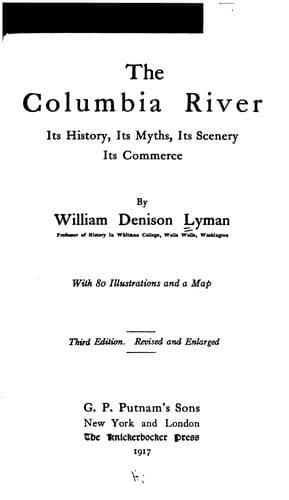
The Columbia River: Its History, Its Myths, Its Scenery, Its CommerceLyman, William Denison
History
The Columbia River: Its History, Its Myths, Its Scenery, Its Commerce
Lyman, William Denison
Columbia River; Columbia River -- Description and travel; Columbia River -- History
The next day, the wind and sea having abated, the _Tonquin_ drew near the
dreaded bar, but, no entrance that satisfied the captain appearing, the
ship again stood off to spend the night in deep water. On the next day,
the 24th, the wind fell and a serene sky seemed to invite another attempt.
The pinnace in command of Mr. Aikin, with two white men and two Kanakas,
was sent out to find the channel. Following the pinnace the ship moved in
so rapidly under a freshening breeze that she passed the pinnace, the
unfortunate men on board finding it impossible to effect an entrance and
being borne by the refluent current into the mad surge where ocean tide
and outflowing river met in foamy strife. So the pinnace disappeared. But
meanwhile the crew had all their energies engaged to save the _Tonquin_.
For the wind failed at the critical moment and the ship struck the sands
with violence. Night came on. Had the men been classically trained (as in
fact Franchere was) they might have remembered Virgil, _Ponto nox incubat
atra_. But they had no time for classical or other quotations. Hastily
dropping the anchors they lay to in the midst of the tumult of waters, in
that worst of situations, on an unknown coast in the dark and in storm.
But as Franchere expresses it, Providence came to their succour, and the
tide flooding and the wind rising, they weighed the anchors, and in spite
of the obscurity of the night, they gained a safe harbour in a little
cove inside of Cape Disappointment, apparently just about abreast of the
present town of Ilwaco.
Thus the _Tonquin_ was saved, and with the light of morning it could be
seen that she was fairly within the bar. Natives soon made their
appearance, desirous of trading beaver-skins. But the crew were in no mood
for commerce while any hope existed for finding the lost sailors. Taking a
course toward the shore by what must have been nearly the present route
from Ilwaco to Long Beach, the captain and a party with him, began a
search and soon found Weeks, one of the crew of the pinnace. He was stark
naked and suffering intensely from the cold. As soon as sufficiently
revived he narrated the loss of the pinnace in the breakers, the death of
three of the crew, and the casting of himself and one of the Kanakas upon
the beach. The point where they were cast would seem to have been near the
present location of the life-saving station.
The two survivors of the ill-fated pinnace having been revived, the party
returned to the _Tonquin_, which was now riding safely at anchor in the
bay on the north side of the river, named Baker's Bay by Broughton
nineteen years before. Joy for their own escape from such imminent perils
was mingled with melancholy at the loss of their eight companions of the
two boats, and with the melancholy there was a sense of bitterness toward
the captain, who was to blame, at least for the loss of the small boat.
Public-domain text, read in full here on John Shaqi.
Reviews
Reviews
No reviews yet
Be the first to share your thoughts on this work.
Elsewhere in the archive
Join the Discussion
Join the discussion
Sign in to leave a comment or review.
Sign InorCreate an account