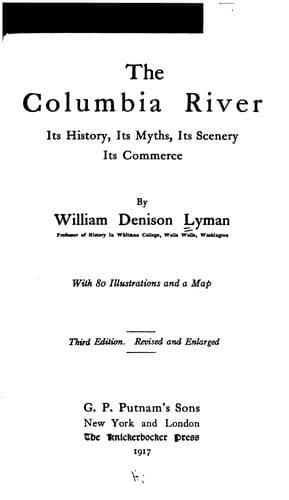
The Columbia River: Its History, Its Myths, Its Scenery, Its CommerceLyman, William Denison
History
The Columbia River: Its History, Its Myths, Its Scenery, Its Commerce
Lyman, William Denison
Columbia River; Columbia River -- Description and travel; Columbia River -- History
However the Astorians decided to send an expedition into the interior to
verify the story given by the two Indian women, but, just as they were
ready to go, a large canoe with the British flag floating from her stern
appeared, from which, when it had reached the landing, there leaped ashore
an active, well-dressed man who introduced himself as David Thompson, of
the North-west Company. This was the same man, the reader will remember,
who had crossed the Rocky Mountains the year before, had wintered near the
head of the River, and had then descended it, seeking a location for the
Columbia River emporium of the Canadian company. But he was too late. It
was quite strange by what narrow margins on several occasions the British
failed to forestall the Yankees.
On July 23d the delayed expedition of the Astorians set forth far to the
interior, and as a result of their investigations, David Stuart, in charge
of the party, began the erection of a trading house at the mouth of the
Okanogan, five hundred and forty miles above Astoria. It was on September
2, 1811, that this post was begun, and hence Fort Okanogan may be
regarded as the first American establishment in the present State of
Washington. It was antedated a few months by the post of the North-west
Company at the entrance of the Little Spokane into the Spokane, near the
present site of the City of Spokane.
During the fall of 1811 the Indians around Astoria became very
threatening. Direful rumours, too, in regard to the destruction of the
_Tonquin_ began to disquiet the Astorians. In the emergency the wary
McDougall, then acting as the head of the Company, bethought himself of a
very effective expedient. He had learned that dreadful loss of life among
the Indians had resulted a few years before from smallpox and that the
Indians were mortally afraid of it. Calling into his room several of the
principal chiefs, he asked if they remembered the smallpox. Their serious
faces were sufficient proof that they did. McDougall then held up a small
vial and continued with awful solemnity: "Listen to me. I am the great
smallpox chief. In this little bottle I keep the smallpox. If I uncork the
bottle and let it out I will kill every man, woman, and child of the
Indians. Now go in peace, but if you make war upon us I will open the
bottle, and you will die." The chiefs filed out in terror, and peace was
preserved.
Public-domain text, read in full here on John Shaqi.
Reviews
Reviews
No reviews yet
Be the first to share your thoughts on this work.
Elsewhere in the archive
Join the Discussion
Join the discussion
Sign in to leave a comment or review.
Sign InorCreate an account