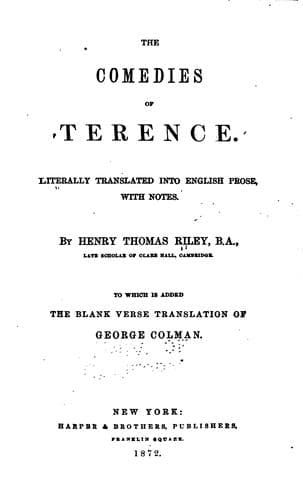
The Comedies of Terence: Literally Translated into English Prose, with NotesTerence
General
The Comedies of Terence: Literally Translated into English Prose, with Notes
Terence
Latin drama (Comedy) -- Translations into English; Terence -- Translations into English
PHOR. I’ll have him here just now. (_To the AUDIENCE._) Fare you well,
and grant us your applause.[91]
ADDITIONAL SCENE.
(_Which is generally considered to be spurious._)
_Enter PHÆDRIA and PHORMIO, from opposite sides of the stage._
PHÆD. Assuredly there is a God, who both hears and sees what we do.
And I do not consider that to be true which is commonly said: “Fortune
frames and fashions the affairs of mankind, just as she pleases.”
PHOR. (_aside._) Heyday! what means this? I’ve met with Socrates, not
Phædria, so far as I see. Why hesitate to go up and address him?
(_Accosting him._) How now, Phædria, whence have you acquired this new
wisdom, and derived such great delight, as you show by your
countenance?
PHÆD. O welcome, {my} friend; O most delightful Phormio, welcome!
There’s not a person in all the world I could more wish just now to
meet than yourself.
PHOR. Pray, tell me what is the matter.
PHÆD. Aye, faith, I have to beg of you, that you will listen to it. My
Pamphila is a citizen of Attica, and of noble birth, and rich.
PHOR. What is it you tell me? Are you dreaming, pray?
PHÆD. Upon my faith, I’m saying what’s true.
PHOR. Yes, and this, too, is a true saying: “You’ll have no great
difficulty in believing that to be true, which you greatly wish {to be
so}.”
PHÆD. Nay, but do listen, I beg of you, to all the wonderful things I
have to tell you of. It was while thinking of this to myself, that I
just now burst forth into those expressions which you heard-- that we,
and what relates to us, are ruled by the sanction of the Gods, {and}
not by blind chance.
PHOR. I’ve been for some time in a state of suspense.
PHÆD. Do you know Phanocrates?
PHOR. As well as {I do} yourself.
PHÆD. The rich man?
PHOR. I understand.
PHÆD. He is the father of Pamphila. Not to detain you, these were the
circumstances: Calchas was his servant, a worthless, wicked fellow.
Intending to run away from the house, he carried off this girl, whom
her father was bringing up in the country, {then} five years old, and,
secretly taking her with him to Eubæa, sold her to Lycus, a merchant.
This person, a long time after, sold her, when now grown up, to Dorio.
She, however, knew that she was the daughter of parents of rank,
inasmuch as she recollected herself being attended {and} trained up by
female servants: the name of her parents she didn’t recollect.
PHOR. How, then, were they discovered?
PHÆD. Stay; I was coming to that. This runaway was caught yesterday,
and sent back to Phanocrates: he related the wonderful circumstances I
have mentioned about the girl, and how she was sold to Lycus, and
afterward to Dorio. Phanocrates sent immediately, and claimed his
daughter; but when he learned that she had been sold, he came running
to me.
PHOR. O, how extremely fortunate!
PHÆD. Phanocrates has no objection to my marrying her; nor has my
father, I imagine.
Public-domain text, read in full here on John Shaqi.
Reviews
Reviews
No reviews yet
Be the first to share your thoughts on this work.
Elsewhere in the archive
Join the Discussion
Join the discussion
Sign in to leave a comment or review.
Sign InorCreate an account