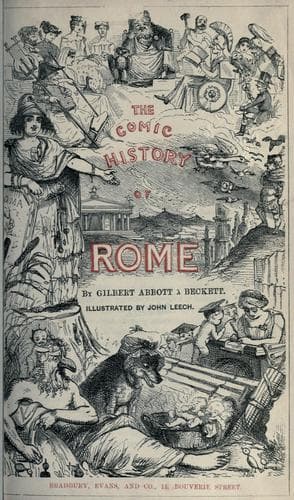
The Comic History of RomeÀ Beckett, Gilbert Abbott
History
The Comic History of Rome
À Beckett, Gilbert Abbott
Rome -- History -- Humor; Wit and humor, Pictorial
One of the Consuls, D. J. Brutus, was sent with troops to Apulia; but
the other Consul, L. Furius Camillus, was in such wretched health, that
he could scarcely hold up his own head, and was quite unfit for the head
of an army. L. Papirius Cursor, the dictator, undertook the command
himself; but on his way to Samnium he was suddenly recalled to Rome, in
consequence of some blunder with the auspices. Leaving behind him Q.
Fabius, his master of the horse, he desired that officer to do nothing;
for L. P. Cursor having taken a cursory view of the state of affairs,
saw there was a victory to be gained, and wished to reserve to himself
the glory of gaining it. Q. Fabius, with a natural reluctance to be
shelved, determined to do the work himself; and by the time his chief
returned, had won a brilliant victory. The rage of the principal knew no
bounds, when he discovered that everything had been accomplished in his
absence; for though there might have been no objection to the
subordinate's actually doing all that was to be done, there was an
unpardonable violation of official etiquette in its having been got
through when the chief was away, and when it was, therefore, notorious
that he could have had no hand in it. The dictator was so indignant,
that he would have visited his deputy with all the severity of military
law, for having dared to show a capacity to command, when his capacity
was, in fact, subordinate. It was looked upon by official men as an act
likely to spoil the official market, by showing that the most
highly-paid services are not always the best; and it was felt, also,
that the chief had been ousted of his prescriptive title to claim, as
his own perquisites, all the tact and talent of his underling.
L. P. Cursor swore vengeance upon the head of Q. Fabius; but the
soldiers threatened a revolt in the event of his being punished, and the
hero who had put a whole army to flight was obliged to take to his heels
for having dared to use his head in the absence of his superior.
The Dictator had rendered himself very unpopular with the troops by his
injustice and cruelty to Q. Fabius; but he regained his popularity by
allowing them to be guilty of all sorts of injustice and cruelty towards
a vanquished enemy. Though their indignation had been raised against
him, through the medium of their generous sympathies, he now appealed to
their meanest passions, by promising them the fullest license in
plundering the foe; and such is the inconsistency of human nature, that
he did not appeal in vain; for, urged by avarice, they fought with such
determination as to secure a victory. Pillage became at once the order
of the day, and a truce was granted for one year, on condition that the
Samnites, who had been robbed of everything available at the moment,
should become responsible for a twelvemonth's pay to the Dictator's
army.
Public-domain text, read in full here on John Shaqi.
Reviews
Reviews
No reviews yet
Be the first to share your thoughts on this work.
Elsewhere in the archive
Join the Discussion
Join the discussion
Sign in to leave a comment or review.
Sign InorCreate an account