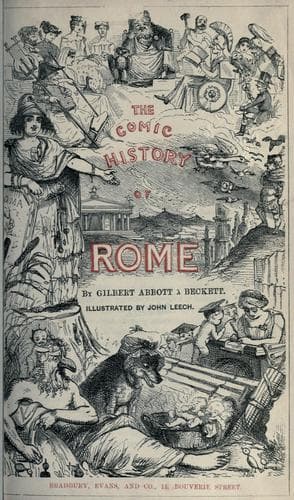
The Comic History of RomeÀ Beckett, Gilbert Abbott
History
The Comic History of Rome
À Beckett, Gilbert Abbott
Rome -- History -- Humor; Wit and humor, Pictorial
Rome had at this time her hands tolerably full, and found employment for
her arms in all directions; when, to add to her embarrassment, the
Cisalpine Gauls were set in a flame by one of the many irons that she
had in the fire. An Agrarian law, proposed by the tribune, C.
Flaminius--whose name savours of the firebrand--was the cause of the
outbreak. The measure enacted, that the land taken from the Gauls should
be distributed among the Romans; and accordingly some settlers were sent
out, who unsettled everything. The Cisalpines commenced negotiations
with their Transalpine allies; but though the negotiations were carried
a very long way, they eventually came to nothing.
Rome was so occupied with foes, that she had scarcely time to turn
round; but when she did turn round, she discovered that some very
objectionable proceedings were being carried on behind her back by a set
of people called the Illyrians. These persons picked up a dishonest
living as pirates, and had plundered, among others, some Italian
merchants who supplied the Italian warehouses of Rome and its
neighbourhood. The Illyrians were ruled over by a woman, named Teuta,
who, when applied to for reparation, observed that she was sorry for
what had occurred, but that piracy was what her subjects got their
living by, and she did not see how she could interfere with the manners
and customs of her people. The Roman ambassadors answered, that the
custom of their country was to protect the injured; but on this
occasion, at least, the country failed in its Protectionist principles,
for the ambassadors were slain before they could get home again. When
their death was known at Rome, every exertion was made to afford them
that protection which came too late to be of any use, and a large army
was sent into the country of the Illyrians. The Roman arms were
perfectly successful, and Teuta was glad to obtain peace by promising to
put down piracy, and by actually putting down a very large sum of money
by way of tribute. Rome had done considerable service to the Isles of
Greece by checking the disreputable trade of piracy; and as the Romans
took evident pride in being noticed by the Greeks, the latter paid the
former for their military aid, by some of those civil attentions which
cost nothing. At Athens, as well as at Corinth, Roman embassies were
received; and though the ambassadors might be considered rather too
venerable for sport, they were allowed to take part in the Isthmian
Games, as well as in the Eleusinian Mysteries.
The Isthmian Games were the same as those at Olympia, of which we
furnish a brief outline for the information of those who feel an
interest in the sporting annals of antiquity.
Public-domain text, read in full here on John Shaqi.
Reviews
Reviews
No reviews yet
Be the first to share your thoughts on this work.
Elsewhere in the archive
Join the Discussion
Join the discussion
Sign in to leave a comment or review.
Sign InorCreate an account