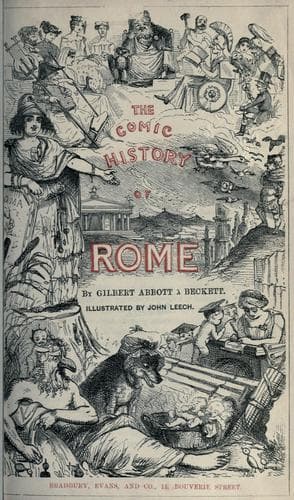
The Comic History of RomeÀ Beckett, Gilbert Abbott
History
The Comic History of Rome
À Beckett, Gilbert Abbott
Rome -- History -- Humor; Wit and humor, Pictorial
In times of extreme peril, it has always been found that two heads,
instead of being better than one, are likely to neutralise each other,
and to reduce the supreme power under one head is the best mode of
making it effectual. The Romans, when seriously threatened by the
Latins, proceeded at once to the appointment of a dictator, from whose
decrees there should be no appeal; so that whatever he said should be no
sooner said than done--a principle of action which contributes
materially to the success of every great enterprise. P. Lartius was the
first dictator; but we can find no traces of his dictation, and he seems
to have been speedily superseded by Aulus Postumius, whose sword is
said to have been known "to bite,"[14]--a propensity which must have
rendered his blade rather liable to snap, unless its temper was
excellent. The appointment of dictator was only for six months; so that
the people were soon absolved from the absolute power under which they
placed themselves. The best piece of patronage at the disposal of the
dictator, was the place of Master of the Horse, which Aulus conferred on
Æbutius; the latter acting completely under the guidance of the former,
who never parted with the reins while deputing the mastership of the
horse to another. Aulus and Æbutius set forward towards the Lake
Regillus, on the margin of which they waited till it was pitch dark
before they pitched their tent, with the intention of preparing for a
pitched battle.
The Latins were led by Mamilius, and the foe being face to face, engaged
themselves hand to hand with the most desperate energy. According to the
legend, Æbutius and Mamilius, meeting in the thick of the fight, came
individually to blows, which resulted in the unhorsing of the Master of
the Horse, who was almost bored to death with the points of the swords
of the enemy. At one time the battle seemed so much in favour of the
Latins, that Aulus entreated the Romans not to resign themselves to the
ravens, to be crowed over in a double sense, by the birds of prey and
the enemy. So mutual was the slaughter, and so equal the bravery on both
sides, that it would have been difficult to decide the battle; and the
legend, in its equal apportionment of valour to each party, would have
come to no practical result, had not supernatural agency stepped in
opportunely to give to one side the victory. Two gigantic youths were
seen fighting on the Roman side, and though nobody knew their names,
their address was the admiration of every one. Their valour was shown at
the expense of the unfortunate Latins, who, unable to sustain the heavy
charge that was now made upon them, made no further attempt to meet any
engagement, but resorted to flight, as the only act that seemed to offer
benefit.
Public-domain text, read in full here on John Shaqi.
Reviews
Reviews
No reviews yet
Be the first to share your thoughts on this work.
Join the Discussion
Join the discussion
Sign in to leave a comment or review.
Sign InorCreate an account