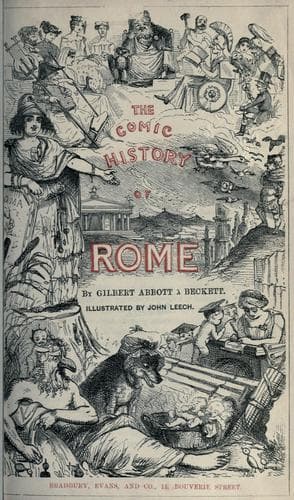
The Comic History of RomeÀ Beckett, Gilbert Abbott
History
The Comic History of Rome
À Beckett, Gilbert Abbott
Rome -- History -- Humor; Wit and humor, Pictorial
The resources of Rome had hitherto been derived from the plunder taken
in war, but the field of battle is always far less fertile than the
field of industry. In the former case, the crop once gathered is
rendered for ever unproductive, and to beat the same enemy twice over,
is like the useless operation of thrashing straw; for if, in either
case, the first thrashing has been complete, there is nothing to be got
by a second. The plebeians had been so long withdrawn from the
cultivation of the land, that they found it extremely awkward to
cultivate a second time an acquaintance once dropped; and the earth
having been hitherto regarded as _infra dig._, was not likely to yield
much to those who had despised until they wanted it. The plebeians could
only reap what they had sown, and as they had sown nothing of any value,
they had fallen into a state of extreme seediness. Begging and borrowing
were the only alternatives of those who could no longer steal, and the
patrician body became a sort of loan society to the plebeians, who
pledged themselves not only morally, but physically, for the return of
the money that had been advanced to them. The law of debtor and creditor
was extremely stringent in ancient Rome; and indeed its stringency
amounted almost to a rope round the debtor's neck; for if he could not
pay within a certain time, he was tied down as the slave of his
creditor. In this position the assailant was called an _addictus_, for
he was regularly sold, without even the equity of redemption being
allowed to him. If the borrower had only pledged himself without an
actual sale, he was simply a _nexus_, with the power of paying off his
debt by either money or work; but if he could do neither, he became an
_addictus_[15] forthwith, when he was thrown into chains, and wore
nothing but the stripes, which were the ordinary livery of that
disgraceful state of servitude.
Public-domain text, read in full here on John Shaqi.
Reviews
Reviews
No reviews yet
Be the first to share your thoughts on this work.
Join the Discussion
Join the discussion
Sign in to leave a comment or review.
Sign InorCreate an account