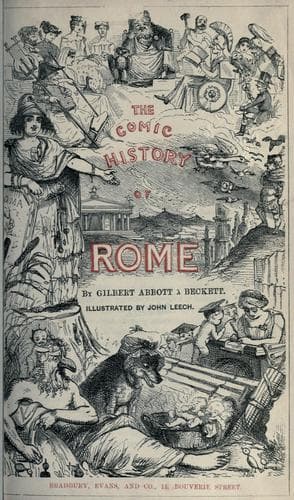
The Comic History of RomeÀ Beckett, Gilbert Abbott
History
The Comic History of Rome
À Beckett, Gilbert Abbott
Rome -- History -- Humor; Wit and humor, Pictorial
The patricians began to be greatly alarmed at the secession of the
plebeians; for though the former had been accustomed to trample the
latter under foot, all the foundations of society seemed to be withdrawn
in the absence of that part which, though it may be called the base, is
essential to the existence of the capital. Rome, in fact, was beginning
to find out that an aristocracy cut off from all connection with the
people at large, is little better than a flower separated from the tree,
and doomed to fall speedily into bad odour. The patrician order happily
recognised the important truth, that the most delicate tendrils owe all
their vitality to the sap, carried up to the top of the tree from those
portions that are in the closest connection with the soil; and steps
were therefore taken to prevent the final severing of the sturdy trunk
from the higher branches. An embassy, consisting of ten patricians, was
sent to negotiate; but as the patricians were no orators, and their
stupidity spoke for itself, Menenius Agrippa, who had once been a
plebeian, was sent as their head, which of course included their
mouth-piece.
Menenius, using his authority as spokesman for the common weal, cited
the fable of the Belly and the Members, to the bellicose _plebs_, who
seemed struck by his relation of it to them, and its own relation to
their existing position. He told them that, once upon a time, all the
members of the human body resolved on aiming a blow at the stomach,
which was accused of leading a life of idleness. The hands struck with
no particular aim; the legs, moved to rebellion, refused to stir; the
eye shut down its lid; the mouth went into open hostility, and the nose
joining in the general blow, there seemed every prospect that the proud
stomach would be glad to eat humble pie in the absence of all other
provisions. It was, however, soon found that, in nourishing their
animosity, the members were keeping all nourishment from themselves, and
that they and their revenge were about equally wasted.
The plebeians, understanding the moral of the story, were disposed to
treat, on the understanding that they should henceforth be better
treated. An agreement was entered into, by which the sponge was to be
applied to all old debts; and all who had lost their liberty by being
the slaves of bad circumstances were restored to freedom. The new
compact provided also for the institution of two officers, named
Tribunes, who were invested with authority over the concerns of the
plebeians; and it was certainly one of the best investments ever made
for the profit of the Roman people. The person of the Tribune was so
sacred, that a common assault upon this officer, when in the execution
of his duty, rendered the assailant liable not merely to be taken up,
but to be knocked down and killed in the streets by any one having a
mania for manslaughter.
Public-domain text, read in full here on John Shaqi.
Reviews
Reviews
No reviews yet
Be the first to share your thoughts on this work.
Elsewhere in the archive
Join the Discussion
Join the discussion
Sign in to leave a comment or review.
Sign InorCreate an account