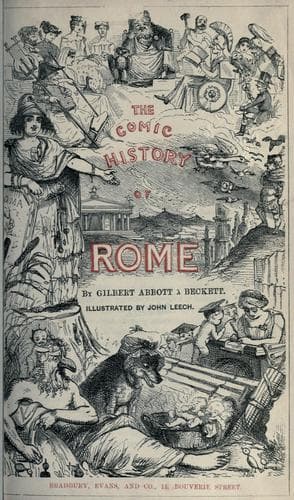
The Comic History of RomeÀ Beckett, Gilbert Abbott
History
The Comic History of Rome
À Beckett, Gilbert Abbott
Rome -- History -- Humor; Wit and humor, Pictorial
The Tribune was allowed such an unlimited liberty of speech, that it was
punishable to interrupt him; and in default of bail, it was death to
cough him down while addressing the people. Even to yawn during one of
his discourses, was to open an abyss into which the yawner might be
plunged before he was aware of it; and the involuntary action of his
distended jaws would often render them the jaws of his own destruction.
The house of the Tribune was open day and night; so that it was as easy
to find one of these officers as it is in these days to find a
policeman, and sometimes rather easier. The Tribunes had power to bring
parties before them, or, in other words, to issue summonses, as well as
to enforce fines, which, if not paid, involved the forfeiture of
property, or, in simpler terms, were recoverable by distress warrant
upon the defaulter's goods and chattels. One of the greatest privileges
of the Tribunes was the right of exercising a veto on any decree of the
senate. Though they had no seats in the assembly, they were permitted to
look in at the door; and if any act was passing that they disapproved,
they had the privilege of exercising, by a shout of "No," a sort of
negative authority. This power of prevention left fewer evils to be
cured; and the plebeians, having at last obtained an organ of their own,
may be said to have found the key to their liberties.
The Tribunes seem to have had power to add to their number, for they
selected three colleagues, soon after they themselves had been chosen;
and, from this time forth, a struggle ensued between plebeian energy,
seeking its fair share of right, and patrician tenacity, holding on with
obstinate determination to exclusive advantages.
Contemporaneously with the institution of the Tribunes, some new
officers were appointed, under the name of Ædiles, who were something
like our Commissioners of Woods and Forests, of Sewers, and of Paving
combined; for they had the care of public buildings, roads, and drains,
as well as of baths and washhouses. They sometimes decided small
disputes, and acted as Inspectors of Markets, examining weights,
settling quarrels, and holding the scales of justice as well as of
merchandise. They kept an eye to unwholesome provisions, and a nose to
stale fish; their ears took cognisance of bad language; in their hands
they carried a staff; and they were, in fact, a curious compound of the
beadle, the commissioner, the policeman, and the magistrate.
While the plebeians had been sulking on the Mons Sacer, a treaty between
the Latins and the Romans had been brought about by Spurius Cassius, a
Consul, who, though his name sounds like counterfeit coin, seems to have
possessed a good deal of the true metal. By the treaty, both nations
were to be almost entirely equal in every respect; and, even with regard
to booty, they were to be on the same footing.
Public-domain text, read in full here on John Shaqi.
Reviews
Reviews
No reviews yet
Be the first to share your thoughts on this work.
Elsewhere in the archive
Join the Discussion
Join the discussion
Sign in to leave a comment or review.
Sign InorCreate an account