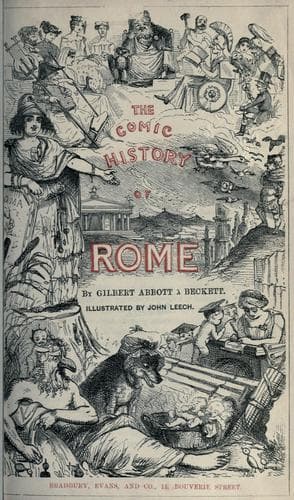
The Comic History of RomeÀ Beckett, Gilbert Abbott
History
The Comic History of Rome
À Beckett, Gilbert Abbott
Rome -- History -- Humor; Wit and humor, Pictorial
His mother, Veturia, following up the advantage that had been gained,
tried the power of the female tongue, to which time seems to go on
adding all the force of which it deprives the rest of the body. The old
lady raved and shouted with a degree of anile energy that struck
Coriolanus with dismay; and when she threw herself on the ground,
declaring he should walk over her body if he attempted to march upon
Rome, he felt that he could not take another step without trampling on
the tenderest relations of humanity. With Volumnia hanging to his neck,
and Veturia clinging to his heels,--with a wife pouring the loudest
lamentations into his ear,--with a mother cursing everything in general,
but his own birthday in particular,--with a bevy of Roman ladies
shrieking and sobbing in the background,--Coriolanus could no longer
resist, but ordered his camp to be broken up, and led his legions back
again. Tradition differs as to the date of the death of Coriolanus, who,
according to some accounts, sunk under the attack made upon him by the
weaker sex; while others assert that he lived to a good old age, which
is likely to have been the case, if the scene we have described was not
immediately the death of him--for the constitution that could have
survived so severe a trial must have been of a strength truly wonderful.
Coriolanus has been held up as a model of disinterestedness, but we
cannot help setting him down as a selfish upstart, who turned traitor to
his country, because it did not form the highest estimate of his
personal merits. His deserts are overbalanced by the fact of his being a
deserter; and it was, assuredly, the reverse of magnanimity to evince
his spite against the nation to which he belonged, merely because his
own value had not been put upon his own services. Such is our view of
Coriolanus without the masquerade dress in which he has been often made
to appear; for truth compels us to take off the gilt in which he has
hitherto shone, and to substitute the guilt that really belongs to him.
The Temple of Fortuna Muliebris was raised, in compliment to the women
who, by their hysterical, and now historical efforts, were said to have
saved Rome; and indeed, considering the frequency with which female
influence operates the other way, the fact of its having been exercised
for the prevention of mischief, deserves the commemoration of a
monument.
FOOTNOTES:
[15] This law is said to have been altered by Servius Tullius; but if
legislation on the subject was at one time loose, it became very binding
afterwards, and was extremely strict at the date above alluded to.
[16] The Curule Chair is said to have been imported, with other articles
of state furniture, from Etruria. In some cases, the feet were formed of
ivory in the shape of elephant's tusks; but there are other proofs of
their Tuscan origin.
CHAPTER THE SEVENTH.
FROM THE CLOSE OF THE WAR WITH THE VOLSCIANS TO THE PASSING OF THE BILL
OF TERENTILLUS.
[Illustration]
Public-domain text, read in full here on John Shaqi.
Reviews
Reviews
No reviews yet
Be the first to share your thoughts on this work.
Elsewhere in the archive
Join the Discussion
Join the discussion
Sign in to leave a comment or review.
Sign InorCreate an account