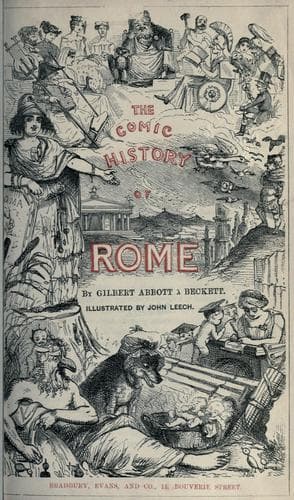
The Comic History of RomeÀ Beckett, Gilbert Abbott
History
The Comic History of Rome
À Beckett, Gilbert Abbott
Rome -- History -- Humor; Wit and humor, Pictorial
There existed at this time a gens in Rome which had managed to obtain
such a share of power for itself, that it was generally recognised as
the governing family. The gens alluded to was that of the Fabii, whose
union formed their chief strength; for no member of the family, though
he might be unmindful of his antecedents, was ever known to forget his
relatives. The Fabii derived their name from Faba, a bean, because their
ancestors had cultivated that kind of pulse; but in later times the gens
became remarkable for feeling the popular pulse, and making a cat's-paw
of the patricians. By an arrangement with the order to which they
belonged, the Fabii were ensured one of the consulships, on condition of
their influencing their clients to elect a patrician to the other; and
thus both the people and the senate were played off against each other
for the special advantage of the "family." Fortunately for society,
there is in all corruption a rottenness which is always bringing it
towards its conclusion while it seems to be gaining its end; and the
usual difficulty of getting unprincipled men to hang long together by a
rope of sand, was illustrated in the case of the patricians and the
Fabii. The quarrels among themselves helped to render them contemptible
to the plebeians, and the troops had become so accustomed to treat their
leaders with disrespect, that many an intended fight ended without a
sword being taken from its sheath, and nothing was drawn but the battle.
One of the Consuls had, for several years, been chosen from the family
of the Fabii; when its members growing tired, at last, of their
patrician stock being a laughing-stock to the army, determined to make
themselves popular. Marcus Fabius won the hearts of the soldiers, by
dressing their wounds, and promising to redress their grievances. Kæso
Fabius, his successor, recommended the distribution of the land among
the plebeians, by whose sweat it had been gained; but he had not been
always equally anxious to acknowledge the claims of popular
perspiration; for he had been one of those who condemned Spurius Cassius
for having made a similar proposition.
Tradition states that the Fabii afterwards emigrated in a body, upwards
of three hundred strong, taking with them four thousand clients; but
whether the clients went at their own solicitation, or whether the Fabii
were the solicitors, we are not in a position to determine. It is said
that the whole party of four thousand three hundred went into action
together, and paid with their lives the costs of the sad affair; but the
critical authorities doubt the whole story; and it is satisfactory to
our best feelings to know that we, on this point, know nothing.[17]
Public-domain text, read in full here on John Shaqi.
Reviews
Reviews
No reviews yet
Be the first to share your thoughts on this work.
Elsewhere in the archive
Join the Discussion
Join the discussion
Sign in to leave a comment or review.
Sign InorCreate an account