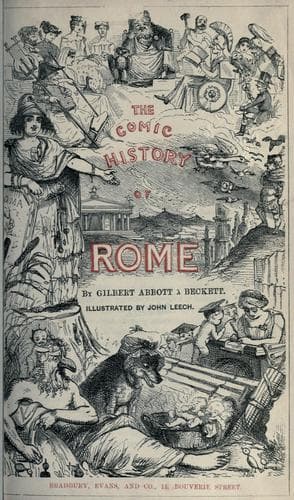
The Comic History of RomeÀ Beckett, Gilbert Abbott
History
The Comic History of Rome
À Beckett, Gilbert Abbott
Rome -- History -- Humor; Wit and humor, Pictorial
The plebeians having got the upper hand, became almost as intolerant as
the tyrants they had displaced,--a common error, unfortunately, among
the professing lovers of liberty. They demanded that the Tribunes should
be restored, which was well enough; that the Tribunate should be
perpetual,--which was an insolent and overbearing interference with the
will of any succeeding generation; and, by way of climax, they required
that any one suggesting the abolition of their favourite office should
be burnt as a traitor. They were no doubt fully justified in having a
will of their own, but they had no authority to entail that will upon a
subsequent age; and least of all had they the right to make bonfires of
those who were of a different way of thinking. It is true that, at such
a moment, few are willing to put their lives literally at stake, by
uttering their opinions; but these arbitrary pranks, so frequently
committed in the name of freedom, account sufficiently for the frequent
use of the words "more free than welcome." The truth is, that when
Liberty becomes a notorious public character, she seems to disappear
from private life; and, indeed, how is she to be found at home, if she
is occupied out of doors, knocking off the hats of those who will not
give her a cheer, or breaking the windows of those who will not
illuminate in her honour?
The plebeians having gained the permission of the Senate to hang and
burn to their hearts' content all who might give way to difference of
opinion, under the weak-minded impression that it would never alter
friendship, proceeded to the election of Tribunes in place of the
Decemvirs, who were thrown into prison. This is said to have been the
first instance of the incarceration of any one belonging to the
patrician order; and the sensation in the upper circles was immense when
they heard that a few exclusives of their own set were in actual
custody. Some aristocratic families went into mourning on the melancholy
occasion, and offered any fine, as a matter of course, for the release
of their kindred.
Appius Claudius and Spurius Appius--probably an illegitimate member of
the family--were thrown into the same cell, where, it is said, they made
away with themselves or each other; but whether there is any truth in
this story of the cell, or whether it is merely a cellular tissue of
falsehood, it is difficult to decide, after so long an interval. The
eight remaining Decemviri went into exile, or, in other words, were
transported for life; while Marcus Claudius, who had claimed Virginia,
repaired to Tibur, now Tivoli, and may be said to have taken his
conscience out to wash in the famous baths of the neighbourhood. Other
authorities say that he fled to avoid the ironing for life with which he
had been threatened, or that he feared the mangling to which he might be
exposed at home, at the hands of the infuriated populace.
Public-domain text, read in full here on John Shaqi.
Reviews
Reviews
No reviews yet
Be the first to share your thoughts on this work.
Elsewhere in the archive
Join the Discussion
Join the discussion
Sign in to leave a comment or review.
Sign InorCreate an account