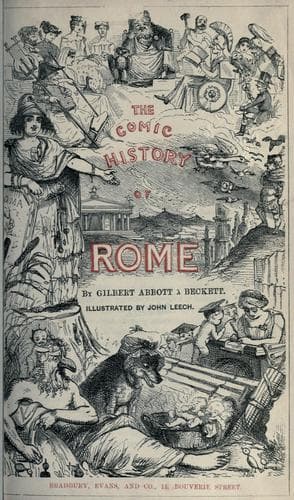
The Comic History of RomeÀ Beckett, Gilbert Abbott
History
The Comic History of Rome
À Beckett, Gilbert Abbott
Rome -- History -- Humor; Wit and humor, Pictorial
In modern times, the nearest approach we have to a triumph is the
entrance into a country town of a company of equestrians, or a
travelling menagerie. The arrangements were in many respects suitable to
a fair, and it would seem to have been the opinion of the Romans that
none but the brave deserved the fair, for it was only the most eminent
warriors who were awarded the honours of a triumph. There was, however,
something very undignified in the practice of hanging about the
outskirts of the town until regularly called in, which was the usual
course adopted by those who anticipated the glory of a summons from the
senate. It sometimes happened that the summons never arrived, and the
General, who had hoped to make his entry in a chariot and four, was at
last compelled to sneak, unattended, into the city. Such might have been
the lot of L. Valerius and M. Horatius, had it not been for their
popularity, aided, probably, by the senseless love of show, which often
causes the hero to be degraded into the mountebank. As triumphs, like
Lord Mayors' shows, were nearly all the same, the following account will
comprehend, or lead the reader to comprehend, the general features of
these military pageants.
The procession opened with a band of trumpeters, and as much breath as
possible was blown out of the whole body. Next came some men with
boards, inscribed with numerous achievements, and forming, in fact, the
posting bills, or puffing placards, of the principal character. These
were followed by a variety of objects, taken from the enemy, and may be
compared to the properties used in the show, the next feature of which
was a file of flute-players, who walked in a sort of fluted column. Next
in order came the white bulls, or oxen devoted for sacrifice,
accompanied by the slaughtering priests, or holy butchers; and
immediately afterwards a remarkable beast, odd fish, or strange bird,
that had been snared, hooked, or caged, in the conquered country. These
were followed by the arms of the foe, with as many captives as possible,
in chains, and the larger the string of fettered victims, so much the
greater was the amount of "linked sweetness, long drawn out" before the
eye of the conqueror. After these were carried the gifts the General had
received from allied or friendly powers, consisting usually of crowns
made of grass, every blade of which was a tribute to the sword of the
victor. Next came a file of lictors, and then the General himself, in a
chariot and four, with a slave on the footboard behind, whispering in
his ear, to remind him of his being still "a man and a brother."
[Illustration: In all probability something of this sort.]
Public-domain text, read in full here on John Shaqi.
Reviews
Reviews
No reviews yet
Be the first to share your thoughts on this work.
Elsewhere in the archive
Join the Discussion
Join the discussion
Sign in to leave a comment or review.
Sign InorCreate an account