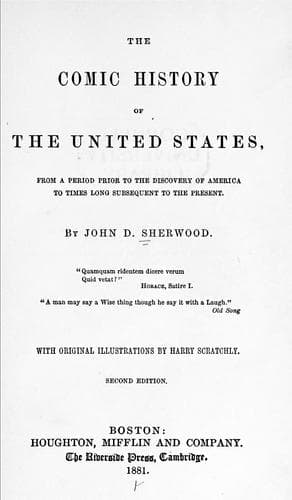
The comic history of the United States, from a period prior to the discovery of America to times long subsequent to the presentSherwood, John D.
History
The comic history of the United States, from a period prior to the discovery of America to times long subsequent to the present
Sherwood, John D.
United States -- History -- Humor
as to take away all their breath. Tights, now unwhisperable except in
veracious histories, held their own with elderly gentlemen to the very
close of the century, and were clasped with silver enough to bring a
smile, in our day, all over the wrinkling face of the Secretary of the
Treasury. The wide-tailed coats and broad-lapelled vests of the
respectable citizens of the Washington and Adams periods would, if worn
now upon the platform of an equal rights convention, make the fame of
their wearers, and insure full-length portraitures of their inner selves
by conversation-drawing correspondents.
[Illustration: 1769. SCHOOL DAYS. 1869.]
Another production of the eighteenth century was better material ways
for translation over the surface of our rapidly augmenting areas. In
1732 enterprising stages took fourteen days from New York to Boston; but
ere the cycle had rounded up to 1800, the time, by reason of better
roads, was reduced one half. The hard earnings, trickling from the
little heaps that labor had gathered up, began to flow out into
turnpikes; and milestones chronicled spaces and pointed the fingers of
Time to measures for ascertaining and so accelerating speed. The
road-maker and the vehicle-propeller are the two Dioscuri of modern
civilization. Whoever subtracts portions of the earth’s surface, be it
solid or aqueous, from between separated States, communities, or
individuals, multiplies the well-being and happiness of the human race.
Could the tea raiser in China be placed alongside of the tea consumer in
America, or the cotton manufacturer of Lowell within a half-hour’s
delivery of his fabrics from their purchaser, the expenses of handling
at either end, the long, costly, tedious voyages that now waste so much
labor, time, and money, and the accumulated taxes upon the articles sold
added by intermediate commissions, would be saved. The costs of
translation are a necessary but onerous assessment upon productive
industry. The greatest invention now needed is one which would so
condense the earth’s bulk by improved and rapid communication, as to
squeeze out the distances that separate nations and chill their natural
outflow from themselves into others.
In 1700 the population of Boston was 7,000; that of New York 5,250, of
which latter one in seven was colored; a proportion which was augmented
in 1711 in favor of the blacks, by the establishment of a regular and
public slave-market. An English traveller describes Boston in 1700 as a
place whose “buildings are, like its women, neat and pretty; the streets
of pebble, like the hearts of the men.” From such flinty masculines no
wonder that the population only reached to 24,937 in the next one
hundred years.
Public-domain text, read in full here on John Shaqi.
Reviews
Reviews
No reviews yet
Be the first to share your thoughts on this work.
Elsewhere in the archive
Join the Discussion
Join the discussion
Sign in to leave a comment or review.
Sign InorCreate an account