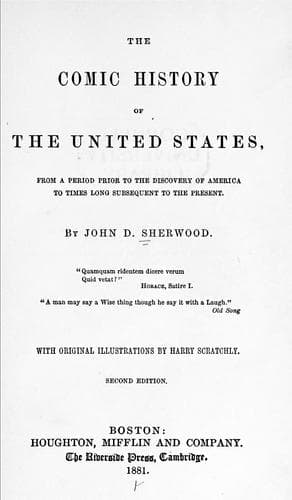
The comic history of the United States, from a period prior to the discovery of America to times long subsequent to the presentSherwood, John D.
History
The comic history of the United States, from a period prior to the discovery of America to times long subsequent to the present
Sherwood, John D.
United States -- History -- Humor
The first book of original poems was by a woman, Mrs. Anne Bradstreet.
The third edition came out in Boston in 1758. Besides this intellectual
progeny, she had eight children; and to these latter she thus alludes in
the printed issue:—
“I had eight birds hatch’t in the nest;
Four cocks there were and hens the rest;
I nurst them up with pains and care,
Nor cost nor labor did I spare,
Till at last they felt their wing,
Mounted the trees and learned to sing.”
During the first half of the century, ecclesiastical and religious
writings in all departments naturally took the lead, as in these
American mind was left free. In this field roamed the two Mathers,
father and son,—Increase, the first, but unfortunately not the last, who
was created a D. D.; and Cotton, who committed nearly three hundred and
eighty-three sins in as many books, with which he loaded down the world,
the greatest like its title, Magnalia. He made a partial atonement in a
few good treatises. In the same department wrought largely, and with a
“Freedom of the Will,” Jonathan Edwards, of whom Dugald Stewart said,
“that in logical acuteness and subtilty he did not yield to any
disputant bred in the universities of Europe”; Samuel Johnson, the first
president of Columbia College, and the father of that highly respectable
family, the American Protestant Episcopal Church; Ezra Stiles, who
delivered orations in good Latin, and found audiences to listen to them;
Timothy Dwight, his successor as president of Yale College, whose
“System of Theology” still claims attention, even among the acute
researches of the bibliologists of our time, and whose four volumes of
“Travels in New England and New York” give rare reading on express
trains; Samuel Hopkins, Joseph Bellamy, William White, the first
American bishop of the Episcopal Church, and whose sweet spirit perfumed
even his controversial writings; Edward Payson, Joseph S. Buckminster,
and many others;—of but few of whom it could be said, “that their works
do follow them”—to silence; for the churches still hold them in living
honor.
Political writings divided with the theological the public mind as soon
as government became domesticated. In books like “The Federalist,”
“Notes on Virginia,” “Discourses on Davila”; in speeches embedding
constitutional argument; in treatises, tracts, and in all forms and ways
known to type, many of the wise men of the Revolution, with James Otis,
Josiah Quincy, Jeremy Belknap, David Ramsey, and others, spake out in
varied logic, historical research, wit, satire, and in captivating
dialogue, discussing principles of government, political ethics, and
social economy.
Public-domain text, read in full here on John Shaqi.
Reviews
Reviews
No reviews yet
Be the first to share your thoughts on this work.
Elsewhere in the archive
Join the Discussion
Join the discussion
Sign in to leave a comment or review.
Sign InorCreate an account