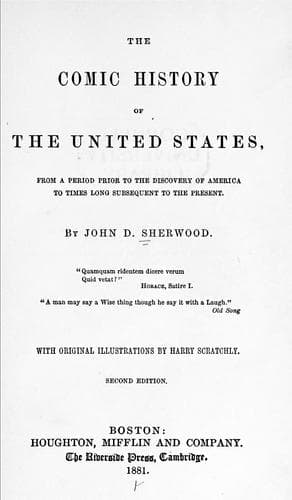
The comic history of the United States, from a period prior to the discovery of America to times long subsequent to the presentSherwood, John D.
History
The comic history of the United States, from a period prior to the discovery of America to times long subsequent to the present
Sherwood, John D.
United States -- History -- Humor
Like Irving, fortunate in the enjoyment of a wide European reputation,
but less fortunate than he in securing the undivided hearts of his
countrymen,—whose early history, aboriginal legends, forest scenery, and
naval characters he has so well tapestried in novels, essay, biography,
and history,—JAMES FENIMORE COOPER, born in 1789, has, by his sea tales,
caused many a mother’s heart to yearn after her runaway boy, and by his
land stories, garnered up many of our best sheaves of fiction into a
national stack. As we gaze on his large, square, massive forehead, we
forget his sharply feathered arrows, aimed at our national faults, which
generally, of course, missed the conscience and touched only the liver.
Remembering “The Pioneers,” “The Last of the Mohicans,” “The Spy,”
“Pilot,” and “Red Rover,” we fall to blessing the creations which stalk
over our rough fences, and brush away our raw villages, uproarious with
faces of civilized red-men, and so endeavor to get by, as boys do a
haunted place at nightfall, the recollection of those twenty-two libel
suits, whose damages he found, like most plaintiffs in that species of
legal fiction, to end in the payment of the costs out of his own pocket.
Others there are, too, whose physiognomies recall to us pleasantly the
explorers in science, workers amid Nature’s secrets, earlier than those
who now push their daring way into her very robing-room: BENJAMIN
SILLIMAN, the elder, who came in 1779, and through a long life lectured
so many into the pleasant idea that they knew something of geology and
chemistry, and through his “Journal of Science,” established in 1818,
gathered up the mental products of his fellow-harvesters; ROBERT HARE,
two years younger, who, at the age of twenty, invented the compound
blow-pipe, and up to his death, in 1858, continued his discoveries,
until he left, by his spiritual explorations, his scientific brethren
behind him; and BENJAMIN RUSH, born in 1780, who by his tasteful style,
made boluses less distasteful, and even gave the muses such a draught
that they became delirious over his medical pages.
WILLIAM H. PRESCOTT, reserved until nearly the close of the eighteenth
century ere he was born, and becoming blind in outward vision at the age
of eighteen, so clarified his inner sight and quickened it to the
perception of new beauties, and so perfected himself by the grace,
gentleness, and cheerful gayety of a happy nature, that Peru, Mexico,
the times of Ferdinand, Isabella, and Philip II., filtrated through
them, glow in splendor and are inwrought and outwrought in such delicacy
of color and such noble boldness as to make him stand out in singularly
beautiful proportions to thousands of loving eyes, that have never
rested, and will now never rest, upon his fine classic head.
Public-domain text, read in full here on John Shaqi.
Reviews
Reviews
No reviews yet
Be the first to share your thoughts on this work.
Elsewhere in the archive
Join the Discussion
Join the discussion
Sign in to leave a comment or review.
Sign InorCreate an account