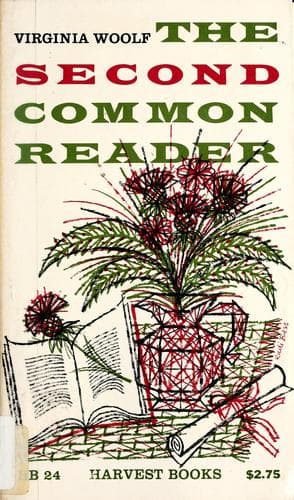
English literature -- History and criticism; Literature, Modern -- History and criticism
intense happiness that we shut the book to feel it better. But always
there is an element of fear which makes us, like Masha, wish to escape
from the gaze which Tolstoi fixes on us. Does it arise from the sense,
which in real life might harass us, that such happiness as he describes
is too intense to last, that we are on the edge of disaster? Or is it
not that the very intensity of our pleasure is somehow questionable and
forces us to ask, with Pozdnyshev in the Kreutzer Sonata, “But why
live?” Life dominates Tolstoi as the soul dominates Dostoevsky. There is
always at the centre of all the brilliant and flashing petals of the
flower this scorpion, “Why live?” There is always at the centre of the
book some Olenin, or Pierre, or Levin who gathers into himself all
experience, turns the world round between his fingers, and never ceases
to ask even as he enjoys it, what is the meaning of it, and what should
be our aims. It is not the priest who shatters our desires most
effectively; it is the man who has known them, and loved them himself.
When he derides them, the world indeed turns to dust and ashes beneath
our feet. Thus fear mingles with our pleasure, and of the three great
Russian writers, it is Tolstoi who most enthralls us and most repels.
But the mind takes its bias from the place of its birth, and no doubt,
when it strikes upon a literature so alien as the Russian, flies off at
a tangent far from the truth.
_Outlines_
I
MISS MITFORD
Speaking truthfully, _Mary Russell Mitford and Her Surroundings_ is not
a good book. It neither enlarges the mind nor purifies the heart. There
is nothing in it about Prime Ministers and not very much about Miss
Mitford. Yet, as one is setting out to speak the truth, one must own
that there are certain books which can be read without the mind and
without the heart, but still with considerable enjoyment. To come to the
point, the great merit of these scrapbooks, for they can scarcely be
called biographies, is that they license mendacity. One cannot believe
what Miss Hill says about Miss Mitford, and thus one is free to invent
Miss Mitford for oneself. Not for a second do we accuse Miss Hill of
telling lies. That infirmity is entirely ours. For example: “Alresford
was the birthplace of one who loved nature as few have loved her, and
whose writings ‘breathe the air of the hayfields and the scent of the
hawthorn boughs’, and seem to waft to us ‘the sweet breezes that blow
over ripened cornfields and daisied meadows’.” It is perfectly true that
Miss Mitford was born at Alresford, and yet, when it is put like that,
we doubt whether she was ever born at all. Indeed she was, says Miss
Hill; she was born “on the 16th December, 1787. ‘A pleasant house in
truth it was,’ Miss Mitford writes. ‘The breakfast-room . . . was a
lofty and spacious apartment.’” So Miss Mitford was born in the
breakfast-room about eight-thirty on a snowy morning between the
Doctor’s second and third cups of tea. “Pardon me,” said Mrs.
Public-domain text, read in full here on John Shaqi.
Reviews
Reviews
No reviews yet
Be the first to share your thoughts on this work.
Elsewhere in the archive
Join the Discussion
Join the discussion
Sign in to leave a comment or review.
Sign InorCreate an account