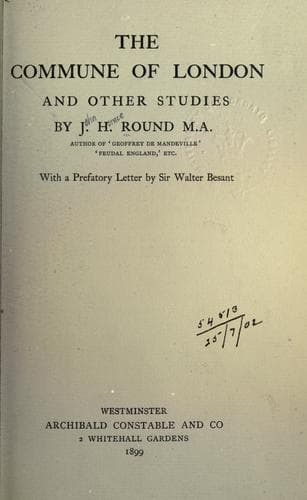
The Commune of London, and other studiesRound, John Horace
History
The Commune of London, and other studies
Round, John Horace
Great Britain -- History -- Norman period, 1066-1154; London (England) -- History -- To 1500
Friends mediate. The archbishop arranges (Many bishops and
with John a conference other of the king’s
for July 28. lieges mediate.)
Longchamp consents, [440]
and withdraws.
Longchamp makes Description of agreement Brief summary
peace as best he between John and of agreement (which
could. Longchamp (wrongly Hovenden recites in
dated April 25). full).
Soon after, Longchamp
hears that his
mercenaries have
landed, and repudiates
the agreement. At
length, however, they
come to terms on a
fresh footing.
It is the contention of Dr. Stubbs that William of Newburgh, in the
first of these columns, describes the first, or spring “campaign,”
and that Richard and the ‘Gesta’ describe, in the other two, the
second “campaign” later in the year. The difficulty I always felt, in
accepting this conclusion, is the almost incredible coincidence of the
sequence of events here described occurring twice over, in exactly
the same order. But one would not be justified in questioning a view
confidently enunciated by Dr. Stubbs, and accepted, it would seem, by
every one else, on the ground merely of improbability, however extreme.
Let us see, therefore, on what evidence the accepted view is based.
In the first place, we are told that the above sequence was repeated
twice over. The authorities, however, are all agreed in mentioning one
such sequence, and one only.[441] Why, then, are we to convert it into
two, in the face of all probability? The only definite reason I can
find for so doing is that, according to William of Newburgh--
Longchamp’s proceedings against Lincoln took place early in the
spring, before the death of pope Clement III. was known, _or
the archbishop of Rouen landed_ [April 27];--[442]
while the ‘Gesta’ distinctly state that Longchamp only set out against
Lincoln “after Midsummer.” If this were so, the discrepancy would be
obvious. But leaving aside, for the moment, the question of the Pope’s
death, we find, on reference, that William of Newburgh, so far from
placing the campaign, etc., _before_ the archbishop’s arrival, actually
places it _after_ that event.[443] The one real discrepancy, therefore,
is found to have no existence.[444]
Public-domain text, read in full here on John Shaqi.
Reviews
Reviews
No reviews yet
Be the first to share your thoughts on this work.
Elsewhere in the archive
Join the Discussion
Join the discussion
Sign in to leave a comment or review.
Sign InorCreate an account