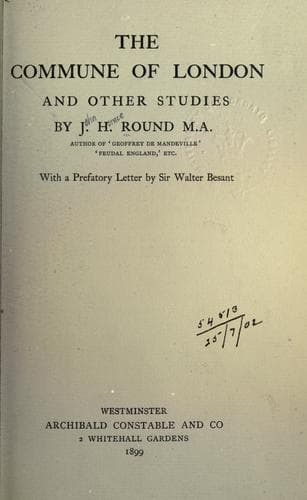
The Commune of London, and other studiesRound, John Horace
History
The Commune of London, and other studies
Round, John Horace
Great Britain -- History -- Norman period, 1066-1154; London (England) -- History -- To 1500
In case any one should still be in doubt, I now bring up my reserves.
The undisputed statement that Longchamp was at Winchester on March 24
was supported, we saw, by record evidence that he was there on March
28. Of more importance is the record evidence that he was at Lincoln
on July 8,[448] for it strongly confirms the statement in the Gesta
that he set out “after midsummer,” and, having rapidly reduced Wigmore,
laid siege to Lincoln Castle. Although I have been trying for years to
collect evidence of Longchamp’s movements in this eventful year, I have
not been able to secure many fixed points. It is certain, however, that
he was at Cambridge on April 21.[449] This affords welcome support to
the crowning discovery I made, in a document preserved in France, that
he was there on April 24.[450] It will, I presume, not be disputed that
if the chancellor was at Cambridge on April 24, he cannot have devoted
the following day to a conference with John at Winchester.
* * * * *
I have purposely refrained as yet from discussing a distinct question,
namely, the terms of the agreement, or agreements, between Longchamp
and John. For they do not affect the question of the sequence of
historical events. We have (_a_) in Hoveden what purports to be an
actual recital of the agreement made after the chancellor’s enforced
withdrawal from Lincoln; (_b_) in Richard of Devizes a _résumé_ of such
an agreement effected, according to him, at a conference on July 28,
also, it would seem, consequent on the chancellor’s retreat.[451] Dr.
Stubbs has argued as against Palgrave, and apparently with complete
success, that two distinct agreements are in question. But this does
not establish their date (or respective dates), nor even their right
sequence. I have already disposed of the alleged conference on April
25, and both agreements, therefore, must be later than the Lincoln
business in July. Now, it is singular that William of Newburgh
distinctly speaks of two agreements, and implies that the second was
the less unfavourable to the chancellor’s claims. This is, at first
sight, in striking harmony with Dr. Stubbs’ conclusion that the
agreement recited by Hoveden is the later of the two, and that in it
“the chancellor gave way somewhat more than was wise, but less than he
had done in April”[452] (_i.e._ in the agreement described by Richard
of Devizes). But a more minute examination than Dr. Stubbs could give
reveals a serious difficulty. According to him, the earlier agreement
“engages the chancellor to support John’s claim to the crown in
case of Richard’s death”;[453] while the later one contains no such
provision. On this distinction he lays stress because “the succession
of Arthur,” he holds, was a “main point” of Longchamp’s policy;[454]
while the archbishop of Rouen also, he urges, would have “sacrificed
other considerations to ... obtaining the omission of any terms which
Public-domain text, read in full here on John Shaqi.
Reviews
Reviews
No reviews yet
Be the first to share your thoughts on this work.
Elsewhere in the archive
Join the Discussion
Join the discussion
Sign in to leave a comment or review.
Sign InorCreate an account