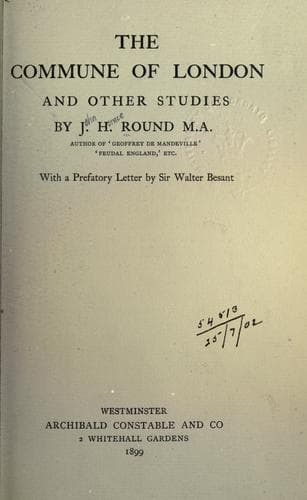
The Commune of London, and other studiesRound, John Horace
History
The Commune of London, and other studies
Round, John Horace
Great Britain -- History -- Norman period, 1066-1154; London (England) -- History -- To 1500
But I would urge that not even the mention of a true _commune_
(“communia”) in a charter proves the adoption of the “Établissements”
at the time. For Henry’s grant of a “communia” to La Rochelle was
made, according to M. Giry, between 1169 and 1178;[514] and yet, as we
have seen, he does not deem the adoption of the “Établissements” at
La Rochelle proved before 1199. In that year Queen Eleanor granted to
Saintes “ut communiam suam teneant secundum formam et modum communie
de Rochella.” Even this, I venture to think, is not actual proof that
the “Établissements de Rouen” had already been adopted at La Rochelle,
though it certainly affords some presumption in favour of that view.
It is only when we turn from this external evidence to the text of
the “Établissements” themselves, that we discover, in two passages, a
direct clue. In these an exception is made in the words: “nisi dominus
rex vel filius ejus adsint Rothomagi vel assisia” (ii. 24, 28). On
these M. Giry writes:
Les articles qui prévoient la présence à Rouen du roi ou de son
fils ne peuvent guère s’appliquer qu’à Henri II. et à Richard
Cœur-de-Lion. C’est donc des dernières années du règne de Henri
II., après l’année 1169, qu’il faut dater la rédaction des
Établissements (i. 11).
Here, then, we have yet another limit--the last (twenty) years of Henry
II. No reference, however, is given for the date “1169” (unless it
applies to La Rochelle--and even then it is wrong).[515] But my point
is that between the years “1169” (or “1177”) and “1183” the king’s son
here mentioned was, obviously, not Richard, but Henry, styled king of
the English and duke of the Normans, from his coronation in 1170 to his
death in 1183. And, even after Henry’s death, Richard was never duke
of the Normans in his father’s lifetime. My own conclusion, therefore,
is that these parts, at least of the “Établissements,” and probably
the whole of them, were composed before the death of the young king in
1183, and probably after his coronation, and admission to a share of
his father’s power, in 1170. Thus they may well have been connected
with Henry’s charter to Rouen granted in 1174–1175.
These considerations may have led us somewhat far afield; but if I am
right in deriving from the Norman capital of our kings the 12th century
“Commune of London,” the origins of the Rouen “Commune” deserve our
careful study. The same MS. which yielded the leading document in this
paper contains two others, of which something must be said. But before
doing so we will glance at one of different origin, which, in more ways
than one, we may associate with the ‘Commune.’
Public-domain text, read in full here on John Shaqi.
Reviews
Reviews
No reviews yet
Be the first to share your thoughts on this work.
Elsewhere in the archive
Join the Discussion
Join the discussion
Sign in to leave a comment or review.
Sign InorCreate an account