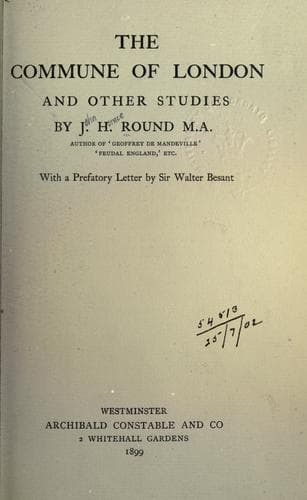
The Commune of London, and other studiesRound, John Horace
History
The Commune of London, and other studies
Round, John Horace
Great Britain -- History -- Norman period, 1066-1154; London (England) -- History -- To 1500
the _sibsceaft_, or kinship, which, when settled within its
own mark of land, is known in early Teutonic history as the
_Markgenossenschaft_. Whether in Greece, Rome, or England,
not to mention other countries, the members of each of these
kinships all bore the same patronymic name, etc., etc.
Take the case of early England, one finds the traces of the
clan of Billingas in Northampton, Lancashire, Durham, Lincoln,
Yorkshire, Sussex, Salop, and other widely-separated districts
(Kemble).
The members of these clans bear each the clan patronymic,
perform the same superstitious rites, and are bound to mutual
defence ... in England a man of the Billinga clan, or of the
Arlinga clan, might be a Somersæta, or a Huicca, or a Lindisfara
by local tribe. This curious scattering of the _family_ names
through the _local_ settlements in England has puzzled Mr.
Kemble, who accounts for it by the confusion of the English
invasion, and by later wandering and colonisations. But if the
Arlingas, Billingas, and so forth, were once scattered over
North Germany, as the men of the Sun or Tortoise clans are
scattered all over America and Australia, it would necessarily
happen that when a Jutland tribe invaded the south of England,
it would leave families settled there of the same name as a
Schleswig tribe would leave in the north or west of England.
Mr. Lang then goes on to urge the probability that, as in Australia,
this phenomenon had its origin in exogamy. But I question, in my paper
on the subject, the ‘clan’ phenomenon itself. Mr. Lang, like others,
wrote under the influence of Kemble; and it is the very object of
my paper to show the danger of building theories on Kemble’s rash
conclusions.
Index
A
_Abattis_, meaning of, 47.
Adrian IV., his alleged donation of Ireland, 171–175, 177–179,
199, 200.
----, his “bull Laudabiliter,” 171 _et seq._
Ailwin (Æthelwine) son of Leofstan, 105, 118.
Albemarle, William earl of, 287.
----, ----, Cecily wife of, 287.
Albert of Lotharingia, “clerk,” 36–38.
Albineio, William de, 152.
Aldermannebury, Simon de, 254.
Aldermen, _see_ London.
Alenzun, Matthew de, 254.
Alexander III., his alleged confirmation of “Laudabiliter,” 172,
176, 180, 182, 184, 185, 189, 193, 198.
----, his ‘Black Book’ letters to Henry II., 172, 173, 174, 175,
185–190, 191–194, 196–199.
Allen, Mr. Grant, 5, 16, 22, 23, 25, 321.
Amiens, _échevins_ of, 235.
Andrew of London, 110, 111.
Andrews, Dr., 19.
Anschetil, 121.
Archer, Mr. T. A., opposed to Mr. Oman, 43, 48, 50, 51.
----, ----, on Strongbow, 309–310.
Archers, English, in 14th century, 296, 297, 299, 300.
Archers in Ireland, use of, 157, 160.
Armies, English, in 14th century, 262 _et seq._
Array, Commissions of, 295, 296.
Public-domain text, read in full here on John Shaqi.
Reviews
Reviews
No reviews yet
Be the first to share your thoughts on this work.
Elsewhere in the archive
Join the Discussion
Join the discussion
Sign in to leave a comment or review.
Sign InorCreate an account