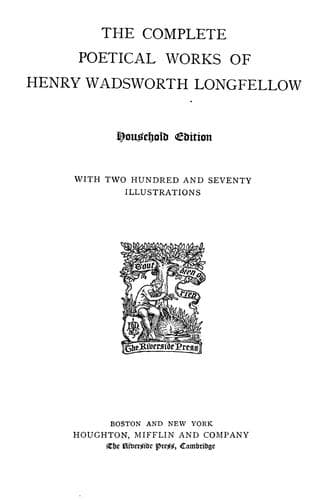
The Complete Poetical Works of Henry Wadsworth LongfellowLongfellow, Henry Wadsworth
General
The Complete Poetical Works of Henry Wadsworth Longfellow
Longfellow, Henry Wadsworth
American poetry
He was known among different tribes by the several names of
Michabou, Chiabo, Manabozo, Tarenyawagon, and Hiawatha. Mr.
Schoolcraft gives an account of him in his Algic Researches, Vol. I.
p. 134; and in his History, Condition, and Prospects of the Indian
Tribes of the United States, Part III. p. 314, may be found the
Iroquois form of the tradition, derived from the verbal narrations
of an Onondaga chief.
Into this old tradition I have woven other curious Indian legends,
drawn chiefly from the various and valuable writings of Mr.
Schoolcraft, to whom the literary world is greatly indebted for his
indefatigable zeal in rescuing from oblivion so much of the
legendary lore of the Indians.
The scene of the poem is among the Ojibways on the southern shore of
Lake Superior, in the region between the Pictured Rocks and the
Grand Sable.
VOCABULARY
Adjidau'mo, the red squirrel.
Ahdeek', the reindeer.
Ahkose'win, fever.
Ahmeek', the beaver.
Algon'quin, Ojibway.
Annemee'kee, the thunder.
Apuk'wa. a bulrush.
Baim-wa'wa, the sound of the thunder.
Bemah'gut, the grapevine.
Be'na, the pheasant.
Big-Sea-Water, Lake Superior.
Bukada'win, famine.
Chemaun', a birch canoe.
Chetowaik', the plover.
Chibia'bos, a musician; friend of Hiawatha; ruler in the Land of Spirits.
Dahin'da, the bull frog.
Dush-kwo-ne'she or Kwo-ne'she, the dragon fly.
Esa, shame upon you.
Ewa-yea', lullaby.
Ghee'zis, the sun.
Gitche Gu'mee, The Big-Sea-Water, Lake Superior.
Gitche Man'ito, the Great Spirit, the Master of Life.
Gushkewau', the darkness.
Hiawa'tha, the Wise Man, the Teacher, son of Mudjekeewis, the
WestWind and Wenonah, daughter of Nokomis.
Ia'goo, a great boaster and story-teller.
Inin'ewug, men, or pawns in the Game of the Bowl.
Ishkoodah', fire, a comet.
Jee'bi, a ghost, a spirit.
Joss'akeed, a prophet.
Kabibonok'ka, the North-Wind.
Kagh, the hedge-hog.
Ka'go, do not.
Kahgahgee', the raven.
Kaw, no.
Kaween', no indeed.
Kayoshk', the sea-gull.
Kee'go, a fish.
Keeway'din, the Northwest wind, the Home-wind.
Kena'beek, a serpent.
Keneu', the great war-eagle.
Keno'zha, the pickerel.
Ko'ko-ko'ho, the owl.
Kuntasoo', the Game of Plum-stones.
Kwa'sind, the Strong Man.
Kwo-ne'she, or Dush-kwo-ne'she, the dragon-fly.
Mahnahbe'zee, the swan.
Mahng, the loon.
Mahn-go-tay'see, loon-hearted, brave.
Mahnomo'nee, wild rice.
Ma'ma, the woodpecker.
Maskeno'zha, the pike.
Me'da, a medicine-man.
Meenah'ga, the blueberry.
Megissog'won, the great Pearl-Feather, a magician, and the Manito
of Wealth.
Meshinau'wa, a pipe-bearer.
Minjekah'wun, Hiawatha's mittens.
Minneha'ha, Laughing Water; wife of Hiawatha; a water-fall in a
stream running into the Mississippi between Fort Snelling and the
Falls of St. Anthony.
Minne-wa'wa, a pleasant sound, as of the wind in the trees.
Mishe-Mo'kwa, the Great Bear.
Mishe-Nah'ma, the Great Sturgeon.
Miskodeed', the Spring-Beauty, the Claytonia Virginica.
Monda'min, Indian corn.
Moon of Bright Nights, April.
Moon of Leaves, May.
Public-domain text, read in full here on John Shaqi.
Reviews
Reviews
No reviews yet
Be the first to share your thoughts on this work.
Elsewhere in the archive
Join the Discussion
Join the discussion
Sign in to leave a comment or review.
Sign InorCreate an account