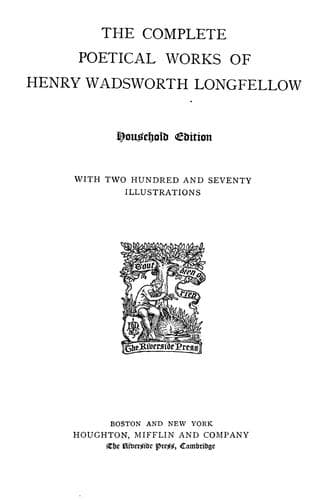
The Complete Poetical Works of Henry Wadsworth LongfellowLongfellow, Henry Wadsworth
General
The Complete Poetical Works of Henry Wadsworth Longfellow
Longfellow, Henry Wadsworth
American poetry
"They were to shoot no other animal," so the legend says, "but such
as each was in the habit of killing. They set out different ways:
Odjibwa, the youngest, had not gone far before he saw a bear, an
animal he was not to kill, by the agreement. He followed him close,
and drove an arrow through him, which brought him to the ground.
Although contrary to the bet, he immediately commenced skinning him,
when suddenly something red tinged all the air around him. He
rubbed his eyes, thinking he was perhaps deceived; but without
effect, for the red hue continued. At length he heard a strange
noise at a distance. It first appeared like a human voice, but
after following the sound for some distance, he reached the shores
of a lake, and soon saw the object he was looking for. At a
distance out in the lake sat a most beautiful Red Swan, whose
plumage glittered in the sun, and who would now and then make the
same noise he had heard. He was within long bow-shot, and, pulling
the arrow from the bowstring up to his ear, took deliberate aim and
shot. The arrow took no effect; and he shot and shot again till his
quiver was empty. Still the swan remained, moving round and round,
stretching its long neck and dipping its bill into the water, as if
heedless of the arrows shot at it. Odjibwa ran home, and got all
his own and his brother's arrows and shot them all away. He then
stood and gazed at the beautiful bird. While standing, he
remembered his brother's saying that in their deceased father's
medicine-sack were three magic arrows. Off he started, his anxiety
to kill the swan overcoming all scruples. At any other time, he
would have deemed it sacrilege to open his father's medicine-sack;
but now he hastily seized the three arrows and ran back, leaving the
other contents of the sack scattered over the lodge. The swan was
still there. He shot the first arrow with great precision, and came
very near to it. The second came still closer; as he took the last
arrow, he felt his arm firmer, and, drawing it up with vigor, saw it
pass through the neck of the swan a little above the breast. Still
it did not prevent the bird from flying off, which it did, however,
at first slowly, flapping its wings and rising gradually into the
airs and teen flying off toward the sinking of the sun."
-- pp.10-12.
When I think of my beloved.
The original of this song may be found in Oneota, p. 15.
Sing the mysteries of Mondamin.
The Indians hold the maize, or Indian corn, in great veneration.
Public-domain text, read in full here on John Shaqi.
Reviews
Reviews
No reviews yet
Be the first to share your thoughts on this work.
Elsewhere in the archive
Join the Discussion
Join the discussion
Sign in to leave a comment or review.
Sign InorCreate an account