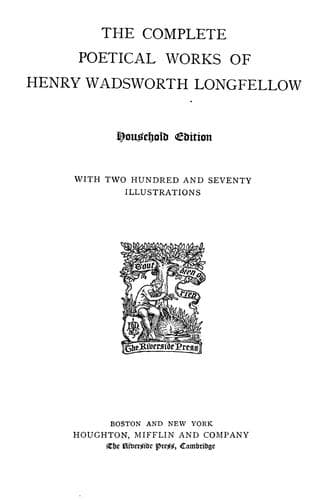
The Complete Poetical Works of Henry Wadsworth LongfellowLongfellow, Henry Wadsworth
General
The Complete Poetical Works of Henry Wadsworth Longfellow
Longfellow, Henry Wadsworth
American poetry
Ah! what would the world be to us
If the children were no more?
We should dread the desert behind us
Worse than the dark before.
What the leaves are to the forest,
With light and air for food,
Ere their sweet and tender juices
Have been hardened into wood,--
That to the world are children;
Through them it feels the glow
Of a brighter and sunnier climate
Than reaches the trunks below.
Come to me, O ye children!
And whisper in my ear
What the birds and the winds are singing
In your sunny atmosphere.
For what are all our contrivings,
And the wisdom of our books,
When compared with your caresses,
And the gladness of your looks?
Ye are better than all the ballads
That ever were sung or said;
For ye are living poems,
And all the rest are dead.
SANDALPHON
Have you read in the Talmud of old,
In the Legends the Rabbins have told
Of the limitless realms of the air,--
Have you read it,--the marvellous story
Of Sandalphon, the Angel of Glory,
Sandalphon, the Angel of Prayer?
How, erect, at the outermost gates
Of the City Celestial he waits,
With his feet on the ladder of light,
That, crowded with angels unnumbered,
By Jacob was seen, as he slumbered
Alone in the desert at night?
The Angels of Wind and of Fire
Chant only one hymn, and expire
With the song's irresistible stress;
Expire in their rapture and wonder,
As harp-strings are broken asunder
By music they throb to express.
But serene in the rapturous throng,
Unmoved by the rush of the song,
With eyes unimpassioned and slow,
Among the dead angels, the deathless
Sandalphon stands listening breathless
To sounds that ascend from below;--
From the spirits on earth that adore,
From the souls that entreat and implore
In the fervor and passion of prayer;
From the hearts that are broken with losses,
And weary with dragging the crosses
Too heavy for mortals to bear.
And he gathers the prayers as he stands,
And they change into flowers in his hands,
Into garlands of purple and red;
And beneath the great arch of the portal,
Through the streets of the City Immortal
Is wafted the fragrance they shed.
It is but a legend, I know,--
A fable, a phantom, a show,
Of the ancient Rabbinical lore;
Yet the old mediaeval tradition,
The beautiful, strange superstition,
But haunts me and holds me the more.
When I look from my window at night,
And the welkin above is all white,
All throbbing and panting with stars,
Among them majestic is standing
Sandalphon the angel, expanding
His pinions in nebulous bars.
And the legend, I feel, is a part
Of the hunger and thirst of the heart,
The frenzy and fire of the brain,
That grasps at the fruitage forbidden,
The golden pomegranates of Eden,
To quiet its fever and pain.
FLIGHT THE SECOND
THE CHILDREN'S HOUR
Between the dark and the daylight,
When the night is beginning to lower,
Comes a pause in the day's occupations,
That is known as the Children's Hour.
Public-domain text, read in full here on John Shaqi.
Reviews
Reviews
No reviews yet
Be the first to share your thoughts on this work.
Elsewhere in the archive