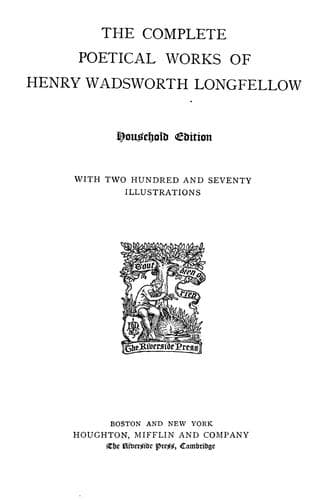
The Complete Poetical Works of Henry Wadsworth LongfellowLongfellow, Henry Wadsworth
General
The Complete Poetical Works of Henry Wadsworth Longfellow
Longfellow, Henry Wadsworth
American poetry
But from the parlor of the inn
A pleasant murmur smote the ear,
Like water rushing through a weir:
Oft interrupted by the din
Of laughter and of loud applause,
And, in each intervening pause,
The music of a violin.
The fire-light, shedding over all
The splendor of its ruddy glow,
Filled the whole parlor large and low;
It gleamed on wainscot and on wall,
It touched with more than wonted grace
Fair Princess Mary’s pictured face;
It bronzed the rafters overhead,
On the old spinet’s ivory keys
It played inaudible melodies,
It crowned the sombre clock with flame,
The hands, the hours, the maker’s name,
And painted with a livelier red
The Landlord’s coat-of-arms again;
And, flashing on the window-pane,
Emblazoned with its light and shade
The jovial rhymes, that still remain,
Writ near a century ago,
By the great Major Molineaux,
Whom Hawthorne has immortal made.
Before the blazing fire of wood
Erect the rapt musician stood;
And ever and anon he bent
His head upon his instrument,
And seemed to listen, till he caught
Confessions of its secret thought,--
The joy, the triumph, the lament,
The exultation and the pain;
Then, by the magic of his art,
He soothed the throbbings of its heart,
And lulled it into peace again.
Around the fireside at their ease
There sat a group of friends, entranced
With the delicious melodies
Who from the far-off noisy town
Had to the wayside inn come down,
To rest beneath its old oak-trees.
The fire-light on their faces glanced,
Their shadows on the wainscot danced,
And, though of different lands and speech,
Each had his tale to tell, and each
Was anxious to be pleased and please.
And while the sweet musician plays,
Let me in outline sketch them all,
Perchance uncouthly as the blaze
With its uncertain touch portrays
Their shadowy semblance on the wall.
But first the Landlord will I trace;
Grave in his aspect and attire;
A man of ancient pedigree,
A Justice of the Peace was he,
Known in all Sudbury as “The Squire.”
Proud was he of his name and race,
Of old Sir William and Sir Hugh,
And in the parlor, full in view,
His coat-of-arms, well framed and glazed,
Upon the wall in colors blazed;
He beareth gules upon his shield,
A chevron argent in the field,
With three wolf’s heads, and for the crest
A Wyvern part-per-pale addressed
Upon a helmet barred; below
The scroll reads, “By the name of Howe.”
And over this, no longer bright,
Though glimmering with a latent light,
Was hung the sword his grandsire bore
In the rebellious days of yore,
Down there at Concord in the fight.
Public-domain text, read in full here on John Shaqi.
Reviews
Reviews
No reviews yet
Be the first to share your thoughts on this work.
Elsewhere in the archive
Join the Discussion
Join the discussion
Sign in to leave a comment or review.
Sign InorCreate an account