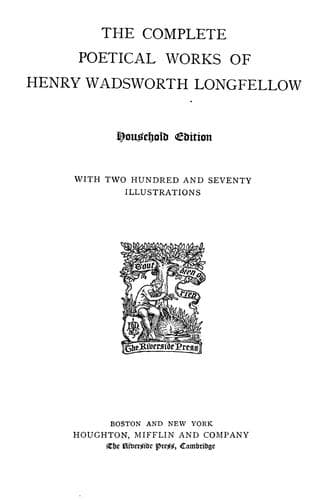
The Complete Poetical Works of Henry Wadsworth LongfellowLongfellow, Henry Wadsworth
General
The Complete Poetical Works of Henry Wadsworth Longfellow
Longfellow, Henry Wadsworth
American poetry
"But lo! your glittering caravan
On the road that leadeth to Ispahan
Hath led us farther to the East
Into the regions of Cathay.
Spite of your Kalif and his gold,
Pleasant has been the tale you told,
And full of color; that at least
No one will question or gainsay.
And yet on such a dismal day
We need a merrier tale to clear
The dark and heavy atmosphere.
So listen, Lordlings, while I tell,
Without a preface, what befell
A simple cobbler, in the year --
No matter; it was long ago;
And that is all we need to know."
THE STUDENT'S TALE
THE COBBLER OF HAGENAU
I trust that somewhere and somehow
You all have heard of Hagenau,
A quiet, quaint, and ancient town
Among the green Alsatian hills,
A place of valleys, streams, and mills,
Where Barbarossa's castle, brown
With rust of centuries, still looks down
On the broad, drowsy land below,--
On shadowy forests filled with game,
And the blue river winding slow
Through meadows, where the hedges grow
That give this little town its name.
It happened in the good old times,
While yet the Master-singers filled
The noisy workshop and the guild
With various melodies and rhymes,
That here in Hagenau there dwelt
A cobbler,--one who loved debate,
And, arguing from a postulate,
Would say what others only felt;
A man of forecast and of thrift,
And of a shrewd and careful mind
In this world's business, but inclined
Somewhat to let the next world drift.
Hans Sachs with vast delight he read,
And Regenbogen's rhymes of love,
For their poetic fame had spread
Even to the town of Hagenau;
And some Quick Melody of the Plough,
Or Double Harmony of the Dove,
Was always running in his head.
He kept, moreover, at his side,
Among his leathers and his tools,
Reynard the Fox, the Ship of Fools,
Or Eulenspiegel, open wide;
With these he was much edified:
He thought them wiser than the Schools.
His good wife, full of godly fear,
Liked not these worldly themes to hear;
The Psalter was her book of songs;
The only music to her ear
Was that which to the Church belongs,
When the loud choir on Sunday chanted,
And the two angels carved in wood,
That by the windy organ stood,
Blew on their trumpets loud and clear,
And all the echoes, far and near,
Gibbered as if the church were haunted.
Outside his door, one afternoon,
This humble votary of the muse
Sat in the narrow strip of shade
By a projecting cornice made,
Mending the Burgomaster's shoes,
And singing a familiar tune:--
"Our ingress into the world
Was naked and bare;
Our progress through the world
Is trouble and care;
Our egress from the world
Will be nobody knows where;
But if we do well here
We shall do well there;
And I could tell you no more,
Should I preach a whole year!"
Public-domain text, read in full here on John Shaqi.
Reviews
Reviews
No reviews yet
Be the first to share your thoughts on this work.
Elsewhere in the archive
Join the Discussion
Join the discussion
Sign in to leave a comment or review.
Sign InorCreate an account