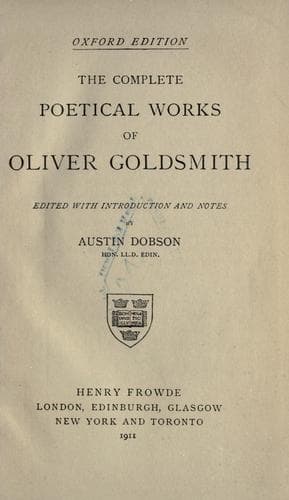
The Complete Poetical Works of Oliver GoldsmithGoldsmith, Oliver
General
The Complete Poetical Works of Oliver Goldsmith
Goldsmith, Oliver
English poetry; Literature -- Collections
Such readers generally admire, etc. ‘I suppose this
paragraph to be directed against Paul Whitehead, or Churchill,’ writes
Mitford. It was clearly aimed at Churchill, since Prior (_Life_,
1837, ii. 54) quotes a portion of a contemporary article in the _St.
James’s Chronicle_ for February 7–9, 1765, attributed to Bonnell
Thornton, which leaves little room for doubt upon the question. ‘The
latter part of this paragraph,’ says the writer, referring to the passage
now annotated, ‘we cannot help considering as a reflection on the memory
of the late Mr. Churchill, whose talents as a poet were so greatly and so
deservedly admired, that during his short reign, his merit in great
measure eclipsed that of others; and we think it no mean acknowledgment of
the excellencies of this poem [_The Traveller_] to say that,
like the stars, they appear the more brilliant now that the sun of our
poetry is gone down.’ Churchill died on the 4th of November, 1764, some
weeks before the publication of _The Traveller_. His powers, it
may be, were misdirected and misapplied; but his rough vigour and his
manly verse deserved a better fate at Goldsmith’s hands.
tawdry was added in the sixth edition of 1770.
blank verse. Cf. _The Present State of Polite
Learning_, 1759, p. 150—‘From a desire in the critic of
grafting the spirit of ancient languages upon the English, has proceeded
of late several disagreeable instances of pedantry. Among the number, I
think we may reckon _blank verse_. Nothing but the greatest sublimity
of subject can render such a measure pleasing; however, we now see it used
on the most trivial occasions’—by which last remark Goldsmith
probably, as Cunningham thinks, intended to refer to the efforts of
Akenside, Dyer, and Armstrong. His views upon blank verse were shared by
Johnson and Gray. At the date of the present dedication, the latest
offender in this way had been Goldsmith’s old colleague on _The
Monthly Review_, Dr. James Grainger, author of _The Sugar Cane_,
which was published in June, 1764. (Cf. also _The Bee_ for 24th
November, 1759, ‘An account of the Augustan Age of England.’)
and that this principle, etc. In the first edition
this read—‘and that this principle in each state, and in our own in
particular, may be carried to a mischievous excess.’
Remote, unfriended, melancholy, slow. Mitford
(Aldine edition, 1831, p. 7) compares the following lines from Ovid:—
Solus, inops, exspes, leto poenaeque relictus.
_Metamorphoses_, xiv. 217.
Exsul, inops erres, alienaque limina lustres, etc.
_Ibis_. 113.
Public-domain text, read in full here on John Shaqi.
Reviews
Reviews
No reviews yet
Be the first to share your thoughts on this work.
Elsewhere in the archive
Join the Discussion
Join the discussion
Sign in to leave a comment or review.
Sign InorCreate an account