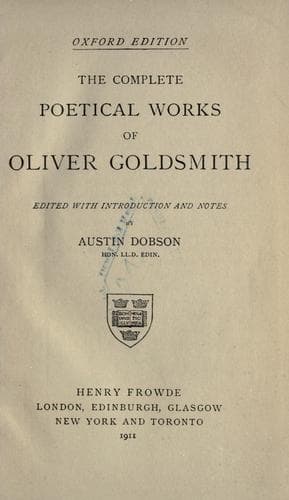
The Complete Poetical Works of Oliver GoldsmithGoldsmith, Oliver
General
The Complete Poetical Works of Oliver Goldsmith
Goldsmith, Oliver
English poetry; Literature -- Collections
a long poem. ‘I might dwell upon such thoughts . .
. were I not afraid of making this preface too tedious; especially since I
shall want all the patience of the reader, for having enlarged it with the
following verses.’ (Tickell’s Preface to Addison’s _ Works_, at
end.)
the increase of our luxuries. The evil of luxury
was a ‘common topick’ with Goldsmith. (Birkbeck Hill’s _Boswell_,
1887, ii. 217–8.) Smollett also, speaking with the voice of Lismahago, and
continuing the quotation on p. 169, was of the opinion that ‘the sudden
affluence occasioned by trade, forced open all the sluices of luxury, and
overflowed the land with every species of profligacy and corruption.’ (_Humphry
Clinker_, 1771, ii. 192.—Letter of Mr. Bramble to Dr. Lewis.)
Sweet AUBURN. Forster, _Life_, 1871, ii.
206, says that Goldsmith obtained this name from Bennet Langton. There is
an Aldbourn or Auburn in Wiltshire, not far from Marlborough, which Prior
thinks may have furnished the suggestion.
Seats of my youth. This alone would imply that
Goldsmith had in mind the environment of his Irish home.
The decent church that topp’d the neighbouring hill.
This corresponds with the church of Kilkenny West as seen from the house
at Lissoy.
[Illustration: ]
KILKENNY WEST CHURCH
(R. H. Newell)
The hawthorn bush. The Rev. Annesley Strean, Henry
Goldsmith’s successor at Kilkenny West, well remembered the hawthorn bush
in front of the village ale-house. It had originally three trunks; but
when he wrote in 1807 only one remained, ‘the other two having been cut,
from time to time, by persons carrying pieces of it away to be made into
toys, etc., in honour of the bard, and of the celebrity of his poem.’ (_Essay
on Light Reading_, by the Rev. Edward Mangin, M.A., 1808, 142–3.)
Its remains were enclosed by a Captain Hogan previously to 1819; but
nevertheless when Prior visited the place in 1830, nothing was apparent
but ‘a very tender shoot [which] had again forced its way to the surface.’
(Prior, _ Life_, 1837, ii. 264.) An engraving of the tree by S.
Alken, from a sketch made in 1806–9, is to be
found at p. 41 of Goldsmith’s _Poetical Works_, R. H. Newell’s
edition, 1811, and is reproduced in the present volume.
[Illustration: ]
HAWTHORN TREE
(R. H. Newell)
How often have I bless’d the coming day. Prior,
_Life_, 1837, ii. 261, finds in this an allusion ‘to the
Sundays or numerous holidays, usually kept in Roman Catholic countries.’
Public-domain text, read in full here on John Shaqi.
Reviews
Reviews
No reviews yet
Be the first to share your thoughts on this work.
Elsewhere in the archive
Join the Discussion
Join the discussion
Sign in to leave a comment or review.
Sign InorCreate an account