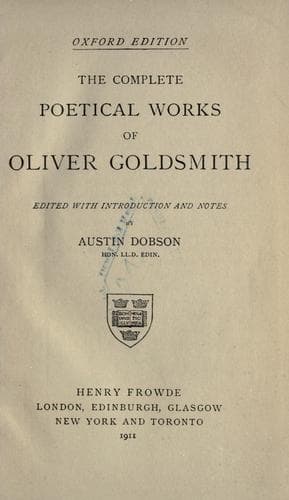
The Complete Poetical Works of Oliver GoldsmithGoldsmith, Oliver
General
The Complete Poetical Works of Oliver Goldsmith
Goldsmith, Oliver
English poetry; Literature -- Collections
On Torno’s cliffs, or Pambamarca’s side.
‘Torno’=Tornea, a river which falls into the Gulf of Bothnia; Pambamarca
is a mountain near Quito, South America. ‘The author’—says Bolton
Corney—‘bears in memory the operations of the French philosophers in
the arctic and equatorial regions, as described in the celebrated
narratives of M. Maupertuis and Don Antonio de Ulloa.’
That trade’s proud empire, etc. These last four
lines are attributed to Johnson on Boswell’s authority:—‘Dr. Johnson
. . . favoured me by marking the lines which he furnished to Goldsmith’s
_ Deserted Village_, which are only the ‘last four’.’ (Birkbeck
Hill’s _Boswell_, 1887, ii. 7.)
PROLOGUE OF LABERIUS.
This translation, or rather imitation, was first published at pp. 176–7 of
_An Enquiry into the Present State of Polite Learning in Europe_,
1759 (Chap. xii, ‘Of the Stage’), where it is prefaced as follows:—
‘MACROBIUS has preserved a prologue, spoken and written by
the poet [Decimus] Laberius, a Roman knight, whom Caesar forced upon the
stage, written with great elegance and spirit, which shews what opinion
the Romans in general entertained of the profession of an actor.’ In the
second edition of 1774 the prologue was omitted. The original lines, one
of which Goldsmith quotes, are to found in the _Saturnalia_ of
Macrobius, lib. ii, cap. vii (_Opera_, London, 1694). He seems
to have confined himself to imitating the first fifteen:—
Necessitas, cujus cursus transversi impetum
Voluerunt multi effugere, pauci potuerunt,
Quo me detrusit paene extremis sensibus?
Quem nulla ambitio, nulla umquam largitio,
Nullus timor, vis nulla, nulla auctoritas
Movere potuit in juventa de statu;
Ecce in senecta ut facile labefecit loco
Viri Excellentis mente clemente edita
Submissa placide blandiloquens oratio!
Etenim ipsi di negare cui nihil potuerunt,
Hominem me denegare quis posset pati?
Ergo bis tricenis annis actis sine tota
Eques Romanus Lare egressus meo
Domum revertar mimus. nimirum hoc die
Uno plus vixi mihi quam vivendum fuit.
Rollin gives a French translation of this prologue in his _Traité
des Études_. It is quoted by Bolton Corney in his _Poetical
Works of Oliver Goldsmith_, 1845, pp. 203–4. In his Aldine edition
of 1831, p. 114, Mitford completed Goldsmith’s version as follows:—
Too lavish still in good, or evil hour,
To show to man the empire of thy power,
If fortune, at thy wild impetuous sway,
The blossoms of my fame must drop away,
Then was the time the obedient plant to strain
When life was warm in every vigorous vein,
To mould young nature to thy plastic skill,
And bend my pliant boyhood to thy will.
So might I hope applauding crowds to hear,
Public-domain text, read in full here on John Shaqi.
Reviews
Reviews
No reviews yet
Be the first to share your thoughts on this work.
Elsewhere in the archive
Join the Discussion
Join the discussion
Sign in to leave a comment or review.
Sign InorCreate an account