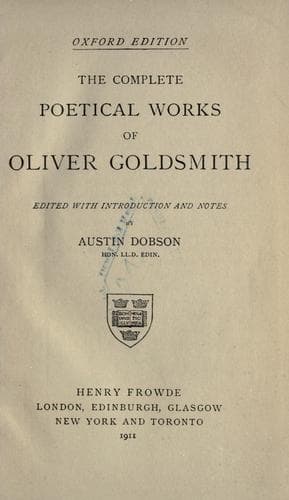
The Complete Poetical Works of Oliver GoldsmithGoldsmith, Oliver
General
The Complete Poetical Works of Oliver Goldsmith
Goldsmith, Oliver
English poetry; Literature -- Collections
Quebec was taken on the 13th September, 1759. Wolfe was wounded pretty
early in the action, while leading the advance of the Louisbourg
grenadiers. ‘A shot shattered his wrist. He wrapped his handkerchief about
it and kept on. Another shot struck him, and he still advanced, when a
third lodged in his breast. He staggered, and sat on the ground.
Lieutenant Brown, of the grenadiers, one Henderson, a volunteer in the
same company, and a private soldier, aided by an officer of artillery who
ran to join them, carried him in their arms to the rear. He begged them to
lay him down. They did so, and asked if he would have a surgeon. “There’s
no need,” he answered; “it’s all over with me.” A moment after, one of
them cried out, “They run; see how they run!” “Who run?” Wolfe demanded,
like a man roused from sleep. “The enemy, sir. They give way everywhere!”
“Go, one of you, to Colonel Burton,” returned the dying man; “tell him to
march Webb’s regiment down to Charles River, to cut off their retreat from
the bridge.” Then, turning on his side, he
murmured, “Now, God be praised, I will die in peace!” and in a few moments
his gallant soul had fled.’ (Parkman’s _Montcalm and Wolfe_,
1885, ii. 296–7.) In his _ History of England in a Series of Letters_,
1764, ii. 241, Goldsmith says of this event:—‘Perhaps the loss of
such a man was greater to the nation than the conquering of all Canada was
advantageous; but it is the misfortune of humanity, that we can never know
true greatness till the moment when we are going to lose it.’* The present
stanzas were first published in _The Busy Body_ (No. vii) for
Tuesday, the 22nd October, 1759, a week after the news of Wolfe’s death
had reached this country (Tuesday the 16th). According to Prior (_Life_,
1837, i. 6), Goldsmith claimed to be related to Wolfe by the father’s
side, the maiden name of the General’s mother being Henrietta Goldsmith.
It may be noted that Benjamin West’s popular rendering of Wolfe’s death
(1771)—a rendering which Nelson never passed in a print shop without
being stopped by it—was said to be based upon the descriptions of an
eye-witness. It was engraved by Woollett and Ryland in 1776. A key to the
names of those appearing in the picture was published in the _Army
and Navy Gazette_ of January 20, 1893.
* He repeats this sentiment, in different words, in the later _History
of England_ of 1771, iv. 400.
AN ELEGY ON MRS. MARY BLAIZE.
Public-domain text, read in full here on John Shaqi.
Reviews
Reviews
No reviews yet
Be the first to share your thoughts on this work.
Elsewhere in the archive
Join the Discussion
Join the discussion
Sign in to leave a comment or review.
Sign InorCreate an account