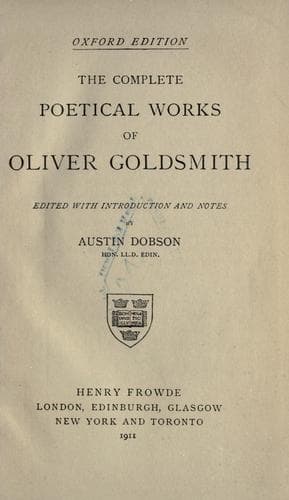
The Complete Poetical Works of Oliver GoldsmithGoldsmith, Oliver
General
The Complete Poetical Works of Oliver Goldsmith
Goldsmith, Oliver
English poetry; Literature -- Collections
And there forlorn, despairing, hid, etc. The first
edition for this and the next two stanzas substitutes the following:—
And there in shelt’ring thickets hid,
I’ll linger till I die;
’Twas thus for me my lover did,
And so for him will I.
‘Thou shalt not thus,’ the Hermit cried,
And clasp’d her to his breast;
The astonish’d fair one turned to chide,—
’Twas Edwin’s self that prest.
For now no longer could he hide,
What first to hide he strove;
His looks resume their youthful pride,
And flush with honest love.
’Twas so for me, etc. Cf. _Gentle Herdsman_:—
Thus every day I fast and pray,
And ever will doe till I dye;
And gett me to some secret place,
For soe did hee, and soe will I.
Forbid it, Heaven. _Vicar of Wakefield_,
first edition, like the version of 1765, has ‘Thou shalt not thus.’
My life. _Vicar of Wakefield_, first
edition, has ‘O thou.’
No, never from this hour, etc. The first edition
reads:—
No, never, from this hour to part,
Our love shall still be new;
And the last sigh that rends thy heart,
Shall break thy Edwin’s too.
The poem then concluded thus:—
Here amidst sylvan bowers we’ll rove,
From lawn to woodland stray;
Blest as the songsters of the grove,
And innocent as they.
To all that want, and all that wail,
Our pity shall be given,
And when this life of love shall fail,
We’ll love again in heaven.
These couplets, with certain alterations in the first and last lines, are
to be found in the version printed in _Poems for Young Ladies_,
1767, p. 98.
AN ELEGY ON THE DEATH OF A MAD DOG.
This poem was first published in _The Vicar of Wakefield_,
1766, i. 175–6, where it is sung by one of the little boys. In common
with the _Elegy on Mrs. Mary Blaize_ (p. 47) it owes something
of its origin to Goldsmith’s antipathy to fashionable elegiacs, something
also to the story of M. de la Palisse. As regards mad dogs, its author
seems to have been more reasonable than many of his contemporaries, since
he ridiculed, with much common sense, their exaggerated fears on this
subject (_v. Chinese Letter_ in _The Public Ledger_
for August 29, 1760, afterwards Letter lxvi of _ The Citizen of the
World_, 1762, ii. 15). But it is ill jesting with hydrophobia. Like
_Madam Blaize_, these verses have been illustrated by Randolph
Caldecott.
In Islington there was a man. Goldsmith had
lodgings at Mrs. Elizabeth Fleming’s in Islington (or ‘Isling town’ as the
earlier editions have it) in 1763–4; and the choice of the locality may
have been determined by this circumstance. But the date of the composition
of the poem is involved in the general obscurity which hangs over the _Vicar_
in its unprinted state. (See _Introduction_,
pp. xviii-xix.)
Public-domain text, read in full here on John Shaqi.
Reviews
Reviews
No reviews yet
Be the first to share your thoughts on this work.
Elsewhere in the archive
Join the Discussion
Join the discussion
Sign in to leave a comment or review.
Sign InorCreate an account