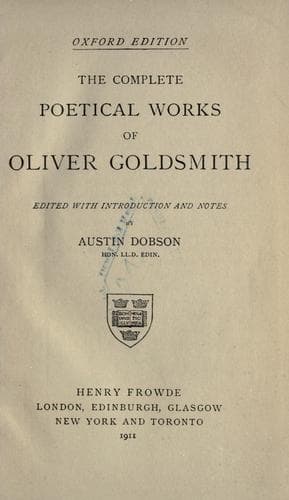
The Complete Poetical Works of Oliver GoldsmithGoldsmith, Oliver
General
The Complete Poetical Works of Oliver Goldsmith
Goldsmith, Oliver
English poetry; Literature -- Collections
same authority it was based upon one of the writer’s own novels, _Henrietta_,
published in 1758. Though tainted with the prevailing sentimentalism,
_The Sister_ is described by Forster as ‘both amusing and
interesting’; and it is probable that it was not fairly treated when it
was acted. Mrs. Lenox (1720–1804), daughter of Colonel Ramsay,
Lieut.-Governor of New York, was a favourite with the literary magnates of
her day. Johnson was half suspected of having helped her in her book on
Shakespeare; Richardson admitted her to his readings at Parson’s Green;
Fielding, who knew her, calls her, in the _Journal of a Voyage to
Lisbon_, 1755, p. 35 (first version), ‘the inimitable author of the
Female Quixote’; and Goldsmith, though he had no kindness for genteel
comedy (see _ post_, p. 228), wrote her this lively epilogue, which
was spoken by Mrs. Bulkley, who personated the ‘Miss Autumn’ of the piece.
Mrs. Lenox died in extremely reduced circumstances, and was buried by the
Right Hon. George Ross, who had befriended her later years. There are
several references to her in Boswell’s _Life of Johnson_. (See
also Hawkins’ _Life_, 2nd ed. 1787, pp. 285–7.)
PROLOGUE TO ‘ZOBEIDE.’
_Zobeide_, a play by Joseph Cradock (1742–1826), of Gumley, in
Leicestershire, was produced by Colman at Covent Garden on Dec. 11, 1771.
It was a translation from three acts of _Les Scythes_, an
unfinished tragedy by Voltaire. Goldsmith was applied to, through the
Yates’s, for a prologue, and sent that here printed to the author of the
play with the following note:—‘Mr. Goldsmith presents his best
respects to Mr. Cradock, has sent him the Prologue, such as it is. He
cannot take time to make it better. He begs he will give Mr. Yates the
proper instructions; and so, even so, commits him to fortune and the
publick.’ (Cradock’s _Memoirs_, 1826, i. 224.) Yates, to the
acting of whose wife in the character of the heroine the success of the
piece, which ran for thirteen nights, was mainly attributable, was to have
spoken the prologue, but it ultimately fell to Quick, later the ‘Tony
Lumpkin’ of _She Stoops to Conquer_, who delivered it in the
character of a sailor. Cradock seems
subsequently to have sent a copy of _ Zobeide_ to Voltaire, who
replied in English as follows:—
9e. 8bre. 1773. à ferney.
Sr.
Thanks to yr muse a foreign copper shines
Turn’d in to gold, and coin’d in sterling lines.
You have done to much honour to an old sick man of eighty.
I am with the most sincere esteem and gratitude
Sr.
Yr. obdt. Servt. Voltaire.
A Monsieur Monsieur J. Cradock.
Public-domain text, read in full here on John Shaqi.
Reviews
Reviews
No reviews yet
Be the first to share your thoughts on this work.
Elsewhere in the archive
Join the Discussion
Join the discussion
Sign in to leave a comment or review.
Sign InorCreate an account