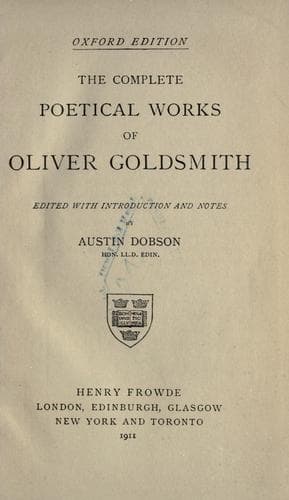
The Complete Poetical Works of Oliver GoldsmithGoldsmith, Oliver
General
The Complete Poetical Works of Oliver Goldsmith
Goldsmith, Oliver
English poetry; Literature -- Collections
For these, and other forgotten pieces arising out of _Retaliation_,
Garrick had apparently prepared the above-mentioned introduction. It may
be added that the statement, prefixed to the first edition, that
_Retaliation_, as we now have it, was produced at the ‘next meeting’ of
the Club, is manifestly incorrect. It was composed and circulated in
detached fragments, and Goldsmith was still working at it when he was
seized with his last illness.
Of old, when Scarron, etc. Paul Scarron (1610–60),
the author _inter alia_ of the _Roman Comique_, 1651–7,
upon a translation
of which Goldsmith was occupied during the last months of his life. It was
published by Griffin in 1776.
Each guest brought his dish. ‘Chez Scarron,’—says
his editor, M. Charles Baumet, when speaking of the poet’s entertainments,—‘venait
d’ailleurs l’élite des dames, des courtisans & des hommes de
lettres. On y dinait joyeusement. _Chacun apportait son plat_.’ (_Œuvres
de Scarron_, 1877, i. viii.) Scarron’s company must have been as
brilliant as Goldsmith’s. Villarceaux, Vivonne, the Maréchal
d’Albret, figured in his list of courtiers; while for ladies he had
Mesdames Deshoulières, de Scudéry, de la Sablière,
and de Sévigné, to say nothing of Ninon de Lenclos and
Marion Delorme. (Cf. also Guizot, _ Corneille et son Temps_,
1862, 429–30.)
If our landlord. The ‘explanatory note’ to the
second edition says—‘The master of the St. James’s coffee-house,
where the Doctor, and the friends he has characterized in this Poem, held
an occasional club.’ This, it should be stated, was not the famous
‘Literary Club,’ which met at the Turk’s Head Tavern in Gerrard Street.
The St. James’s Coffee-house, as familiar to Swift and Addison at the
beginning, as it was to Goldsmith and his friends at the end of the
eighteenth century, was the last house but one on the south-west corner
of St. James’s Street. It now no longer exists. Cradock (_Memoirs_,
1826, i. 228–30) speaks of dining _at the bottom of St. James’s Street_
with Goldsmith, Percy, the two Burkes (_v. infra_), Johnson, Garrick,
Dean Barnard, and others. ‘We sat very late;’ he adds in conclusion, ‘and
the conversation that at last ensued, was the direct cause of my friend
Goldsmith’s poem, called “_Retaliation._”’
Our Dean. Dr. Thomas Barnard, an Irishman, at this
time Dean of Derry. He died at Wimbledon in 1806. It was Dr. Barnard who,
in reply to a rude sally of Johnson, wrote the charming verses on
improvement after the age of forty-five, which end—
If I have thoughts, and can’t express them,
Gibbon shall teach me how to dress them,
In terms select and terse;
Jones teach me modesty and Greek,
Smith how to think, Burke how to speak,
And Beauclerk to converse.
Public-domain text, read in full here on John Shaqi.
Reviews
Reviews
No reviews yet
Be the first to share your thoughts on this work.
Elsewhere in the archive
Join the Discussion
Join the discussion
Sign in to leave a comment or review.
Sign InorCreate an account