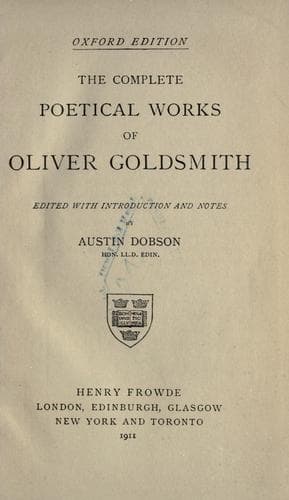
The Complete Poetical Works of Oliver GoldsmithGoldsmith, Oliver
General
The Complete Poetical Works of Oliver Goldsmith
Goldsmith, Oliver
English poetry; Literature -- Collections
Cunningham quotes a similar idea from T. Brown’s _Laconics, Works_,
1709, iv. 14. ‘To treat a poor wretch with a bottle of Burgundy, or fill
his snuff-box, is like giving a pair of lace ruffles to a man that has
never a shirt on his back.’ But Goldsmith, as was his wont, had already
himself employed the same figure. ‘Honours to one in my situation,’ he
says in a letter to his brother Maurice, in January, 1770, when speaking
of his appointment as Professor of Ancient History to the Royal Academy,
‘are something like ruffles to a man that wants a shirt’ (_Percy
Memoir_, 1801, 87–8). His source was probably, not Brown’s _Laconics_,
but those French ‘ana’ he knew so well. According to M. J. J. Jusserand (_English
Essays from a French Pen_, 1895, pp. 160–1), the originator of this
conceit was M. Samuel de Sorbieres, the traveller in England who was
assailed by Bishop Sprat. Considering himself inadequately rewarded by his
patrons, Mazarin, Louis XIV, and Pope Clement IX, he said bitterly—‘They
give lace cuffs to a man without a shirt’; a ‘consolatory witticism’ which
he afterwards remodelled into, ‘I wish they would send me bread for the
butter they kindly provided me with.’ In this form it appears in the
Preface to the _Sorberiana_, Toulouse, 1691.
_a flirt_ is a jibe or jeer. ‘He would sometimes . . . cast out a
jesting _flirt_ at me.’ (Morley’s _History of Thomas Ellwood_,
1895, p. 104.) Swift also uses the word.
An under-bred, fine-spoken fellow, etc. The first
version reads—
A fine-spoken Custom-house Officer he,
Who smil’d as he gaz’d on the Ven’son and me.
but I hate ostentation. Cf. Beau Tibbs:—‘She
was bred, _but that’s between ourselves_, under the inspection of the
Countess of All-night.’ (_Citizen of the World_, 1762, i.
238.)
We’ll have Johnson, and Burke. Cf. Boileau, _Sat._
iii. ll. 25–6, which Goldsmith had in mind:—
Molière avec Tartufe y doit jouer son rôle,
Et Lambert, qui plus est, m’a donné sa parole.
What say you—a pasty? It shall, and it must.
The first version reads—
I’ll take no denial—you shall, and you must.
Mr. J. H. Lobban, _Goldsmith, Select Poems_, 1900, notes a
hitherto undetected similarity between this and the ‘It _must_, and
it _shall_ be a barrack, my life’ of Swift’s _Grand Question
Debated_. See also ll. 56 and 91.
No stirring, I beg—my dear friend—my dear
friend. In the first edition—
No words, my dear GOLDSMITH! my very good Friend!
Mr. Lobban compares:—
‘Good morrow, good captain.’ ‘I’ll wait on you down,’—
‘You shan’t stir a foot.’ ‘You’ll think me a clown.’
Public-domain text, read in full here on John Shaqi.
Reviews
Reviews
No reviews yet
Be the first to share your thoughts on this work.
Elsewhere in the archive
Join the Discussion
Join the discussion
Sign in to leave a comment or review.
Sign InorCreate an account