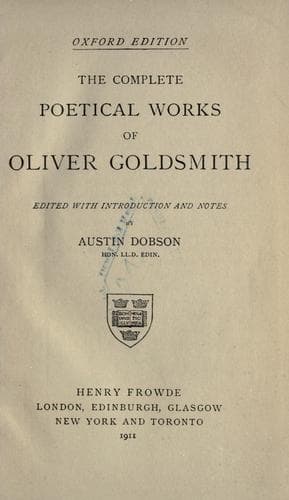
The Complete Poetical Works of Oliver GoldsmithGoldsmith, Oliver
General
The Complete Poetical Works of Oliver Goldsmith
Goldsmith, Oliver
English poetry; Literature -- Collections
The occasion of this quatrain, first published as Goldsmith’s* in _Poems
and Plays_, 1777, p. 79, is to be found in Forster’s _Life and
Times of Oliver Goldsmith_, 1871, ii. 60. Purdon died on March 27,
1767 (_Gentleman’s Magazine_, April, 1767, p. 192). ‘“Dr.
Goldsmith made this epitaph,” says William Ballantyne [the author of _Mackliniana_],
“in his way from his chambers in the Temple to the Wednesday evening’s
club at the Globe. _I think he will never come back_, I believe he
said. I was
sitting by him, and he repeated it more than twice. (I think he will never
come back.)”’ Purdon had been at Trinity College, Dublin, with Goldsmith;
he had subsequently been a foot soldier; ultimately he became a
‘bookseller’s hack.’ He wrote an anonymous letter to Garrick in 1759, and
translated the _ Henriade_ of Voltaire. This translation
Goldsmith is supposed to have revised, and his own life of Voltaire was to
have accompanied it, though finally the Memoir and Translation seem to
have appeared separately. (Cf. prefatory note to _Memoirs of M. de
Voltaire_ in Gibbs’s _Works of Oliver Goldsmith_, 1885,
iv. 2.)
* It had previously appeared as an extempore by a correspondent in
the _Weekly Magazine_, Edin., August 12, 1773 (_Notes and
Queries_, February 14, 1880).
Forster says further, in a note, ‘The original . . . is the epitaph on “La
Mort du Sieur Etienne”:—
Il est au bout de ses travaux,
Il a passé, le Sieur Etienne;
En ce monde il eut tant des maux
Qu’on ne croit pas qu’il revienne.
With this perhaps Goldsmith was familiar, and had therefore less scruple
in laying felonious hands on the epigram in the _Miscellanies_
(Swift, xiii. 372):—
Well, then, poor G—— lies underground!
So there’s an end of honest Jack.
So little justice here he found,
’Tis ten to one he’ll ne’er come back.’
Mr. Forster’s ‘felonious hands’ recalls a passage in Goldsmith’s _Life
of Parnell_, 1770, in which, although himself an habitual sinner in
this way, he comments gravely upon the practice of plagiarism:—‘It
was the fashion with the wits of the last age, to conceal the places from
whence they took their hints or their subjects. A trifling acknowledgment
would have made that lawful prize, which may now be considered as plunder’
(p. xxxii).
EPILOGUE FOR LEE LEWES’S BENEFIT.
Public-domain text, read in full here on John Shaqi.
Reviews
Reviews
No reviews yet
Be the first to share your thoughts on this work.
Elsewhere in the archive
Join the Discussion
Join the discussion
Sign in to leave a comment or review.
Sign InorCreate an account