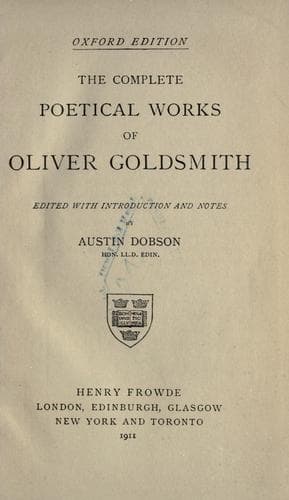
The Complete Poetical Works of Oliver GoldsmithGoldsmith, Oliver
General
The Complete Poetical Works of Oliver Goldsmith
Goldsmith, Oliver
English poetry; Literature -- Collections
This elegy (by Mr. Ticknell) is one of the finest in our language; there
is so little new that can be said upon the death of a friend, after the
complaints of Ovid and the Latin Italians, in this way, that one is
surprised to see so much novelty in this to strike us, and so much
interest to affect.
COLIN AND LUCY.
Through all Tickell’s works there is a strain of ballad-thinking, if I may
so express it; and, in this professed ballad, he seems to have surpassed
himself. It is, perhaps, the best in our language in this way.
THE TEARS OF SCOTLAND.
WRITTEN IN THE YEAR
MDCCXLVI.
This ode, by Dr. Smollett, does rather more honour to the author’s
feelings than his taste. The mechanical part, with regard to numbers and
language, is not so perfect as so short a work as this requires; but the
pathetic it contains, particularly in the last stanza but one, is
exquisitely fine.
ON THE DEATH OF THE LORD PROTECTOR.
Our poetry was not quite harmonized in Waller’s time; so that this, which
would be now looked upon as a slovenly sort of versification, was, with
respect to the times in which it was written, almost a prodigy of harmony.
A modern reader will chiefly be struck with the strength of thinking, and
the turn of the compliments bestowed upon the usurper. Everybody has heard
the answer our poet made Charles II; who asked him how his poem upon
Cromwell came to be finer than his panegyric upon himself. ‘Your majesty,’
replies Waller, ‘knows, that poets always succeed best in fiction.’
THE STORY OF PHOEBUS AND DAPHNE APPLIED.
The French claim this [by Mr. Waller] as belonging to them. To whomsoever
it belongs the thought is finely turned.
NIGHT THOUGHTS.
BY DR. YOUNG.
These seem to be the best of the collection; from whence only the two
first are taken. They are spoken of differently, either with exaggerated
applause or contempt, as the reader’s disposition is either turned to
mirth or melancholy.
SATIRE I.
Young’s Satires were in higher reputation when published, than they stand
in at present. He seems fonder of dazzling than pleasing; of raising our
admiration for his wit, than our dislike of the follies he ridicules.
A PASTORAL BALLAD.
These ballads of Mr. Shenstone are chiefly commended for the natural
simplicity of the thoughts and the harmony of the versification. However,
they are not excellent in either.
PHOEBE. A PASTORAL.
This, by Dr. Byrom, is a better effort than the preceding [a ballad by
Shenstone].
A SONG.
This [‘Despairing beside a clear stream’] by Mr. Rowe, is better than
anything of the kind in our language.
AN ESSAY ON POETRY.
Public-domain text, read in full here on John Shaqi.
Reviews
Reviews
No reviews yet
Be the first to share your thoughts on this work.
Elsewhere in the archive
Join the Discussion
Join the discussion
Sign in to leave a comment or review.
Sign InorCreate an account