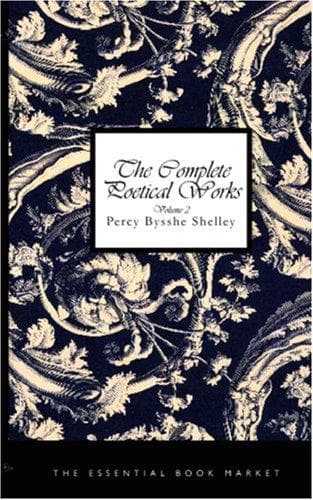
The Complete Poetical Works of Percy Bysshe Shelley — Volume 2Shelley, Percy Bysshe
General
The Complete Poetical Works of Percy Bysshe Shelley — Volume 2
Shelley, Percy Bysshe
English poetry
With this last year of the life of Shelley these Notes end. They are
not what I intended them to be. I began with energy, and a burning
desire to impart to the world, in worthy language, the sense I have of
the virtues and genius of the beloved and the lost; my strength has
failed under the task. Recurrence to the past, full of its own deep and
unforgotten joys and sorrows, contrasted with succeeding years of
painful and solitary struggle, has shaken my health. Days of great
suffering have followed my attempts to write, and these again produced
a weakness and languor that spread their sinister influence over these
notes. I dislike speaking of myself, but cannot help apologizing to the
dead, and to the public, for not having executed in the manner I
desired the history I engaged to give of Shelley's writings. (I at one
time feared that the correction of the press might be less exact
through my illness; but I believe that it is nearly free from error.
Some asterisks occur in a few pages, as they did in the volume of
"Posthumous Poems", either because they refer to private concerns, or
because the original manuscript was left imperfect. Did any one see the
papers from which I drew that volume, the wonder would be how any eyes
or patience were capable of extracting it from so confused a mass,
interlined and broken into fragments, so that the sense could only be
deciphered and joined by guesses which might seem rather intuitive than
founded on reasoning. Yet I believe no mistake was made.)
The winter of 1822 was passed in Pisa, if we might call that season
winter in which autumn merged into spring after the interval of but few
days of bleaker weather. Spring sprang up early, and with extreme
beauty. Shelley had conceived the idea of writing a tragedy on the
subject of Charles I. It was one that he believed adapted for a drama;
full of intense interest, contrasted character, and busy passion. He
had recommended it long before, when he encouraged me to attempt a
play. Whether the subject proved more difficult than he anticipated, or
whether in fact he could not bend his mind away from the broodings and
wanderings of thought, divested from human interest, which he best
loved, I cannot tell; but he proceeded slowly, and threw it aside for
one of the most mystical of his poems, the "Triumph of Life", on which
he was employed at the last.
Public-domain text, read in full here on John Shaqi.
Reviews
Reviews
No reviews yet
Be the first to share your thoughts on this work.
Elsewhere in the archive
Join the Discussion
Join the discussion
Sign in to leave a comment or review.
Sign InorCreate an account