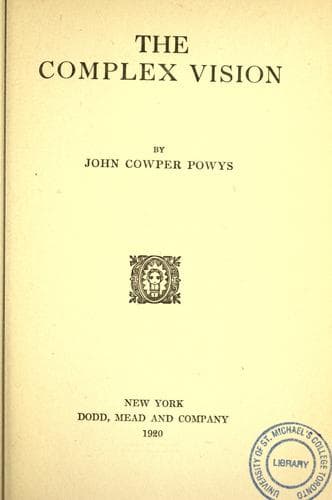
The only way in which we can really escape from the rigid
conceptualism of rational logic is to accept the judgment of the
totality of man's nature. And the judgment of the totality of man's
nature points unmistakably to the existence of a real substantial
soul. Such a soul is the indispensable implication of personality.
And the most interior and intimate knowledge that we are in
possession of, or shall ever be in possession of, is the knowledge
of personality.
Bergson is perfectly right when he asserts that "the consciousness
which we have of our own self" introduces us "to the interior of a
reality, on the model of which we must represent other realities."
But Bergson is surely departing both from the normal facts of
ordinary introspection and from the exceptional facts of abnormal
illumination when he appends to the words "the consciousness
which we have of our own self" the further words in its continual
"flux." For in our normal moods of human introspection, as well
as in our abnormal moods of superhuman illumination, what we
are conscious of most of all is a sense of integral continuity in the
midst of change, and of identical permanence in the midst of ebb
and flow.
The flux of things does most assuredly rush swiftly by us; and we,
in our inmost selves, are conscious of life's incessant flow. But
how could we be conscious of any of this turbulent movement
across the prow of our voyaging ship, if the ship itself--the
substantial base of our living consciousness--were not an
organized and integral reality, of psycho-chemical material, able to
exert will and to make use of memory and reason in its difficult
struggle with the waves and winds?
The revelation of man's complex vision with regard to the
personality of the soul is a thing of far-reaching issues and
implications. One of these implications is that while we have the
right to the term "the eternal flux" in regard to the changing waves
of sensations and ideas that pass across the horizon of the soul's
vision we have no right to think of this "eternal flux" as anything
else than the pressure upon us of the universe of our own vision
and the pressure upon us of the universe of other visions, as they
seem, for this or that passing moment, to be different from our
own.
The kind of world to which we are thus committed is a world
crowded with living personalities. Each of these personalities
brings with it its own separate universe. But the fact that all these
separate universes find their ideal synthesis or teleological
orientation in "the vision of the immortals," justifies us in
assuming that in a certain eternal sense all these apparently
conflicting universes are in reality one. This unity of ideas, with its
predominant aesthetic idea--the idea of beauty--and its
predominant emotional idea--the idea of love--helps us towards a
synthesis which is after all only a dynamic one, a thing of
movement, growth and creation.
Public-domain text, read in full here on John Shaqi.
Reviews
Reviews
No reviews yet
Be the first to share your thoughts on this work.
Elsewhere in the archive
Join the Discussion
Join the discussion
Sign in to leave a comment or review.
Sign InorCreate an account