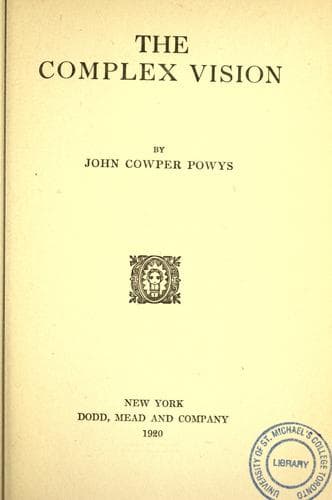
The philosophy of the complex vision is compelled by the very
nature of its organ of research to choose, in this dilemma, the latter
rather than the former. And the universe which it thus dares to
predicate is at least a universe that lends itself, as so many
"scientific" universes do not, to that synthetic activity of the
_imaginative reason_ which in the long run alone satisfies the
soul. And such a universe satisfies the soul, as these others cannot,
because it reflects, in its objective spectacle of things, the
profoundest interior consciousness of the actual living self which
the soul in its deepest moments of introspection is able to grasp.
Modern science, under the rhetorical spell of this talismanic word
"evolution," seems to imply that it can explain the multiform
shapes and appearances of organic life by deducing them, in all
their vivid heterogeneity, from some hypothetical monistic
substance which it boldly endows with the mysterious energy
called the "life-force" and which it then permits to project out of
itself, by some sort of automatic volition, the whole long historic
procession of living organisms.
This purely imaginative assumption gives it, in the popular mind, a
sort of vague right to make the astounding claim that it has
"explained" the origin of things. Little further arrogance is needed
to give it, in the popular mind, the still more astounding right to
claim that it has indicated not only the nature of the "beginning" of
things but the nature of their "end" also; this "end" being nothing
less than some purely hypothetical "equilibrium" when the
movement of "advance," coming full circle, rounds itself off into
the movement of "reversion."
The philosophy of the complex vision makes no claim to deal
either with the beginning of things or with the end of things. It
recognizes that "beginnings" and "ends" are not things with which
we can intelligibly deal; are, on the contrary, things which are
completely unthinkable.
What we actually see, feel, divine, imagine, love, hate, detest,
desire, dream, create and destroy--these living, dying, struggling,
relaxing, advancing and retreating things--this space, this ether,
these stars and suns, these animals, fishes, birds, plants, this earth
and moon, these men and these trees and flowers, these high and
unchanging eternal ideas of the beautiful and the good, these
transitory perishing mortal lives and these dimly discerned
immortal figures that we name "gods," all these, as far as we are
concerned, have for ever existed, all these, as far as we are
concerned, must for ever exist.
Public-domain text, read in full here on John Shaqi.
Reviews
Reviews
No reviews yet
Be the first to share your thoughts on this work.
Elsewhere in the archive
Join the Discussion
Join the discussion
Sign in to leave a comment or review.
Sign InorCreate an account