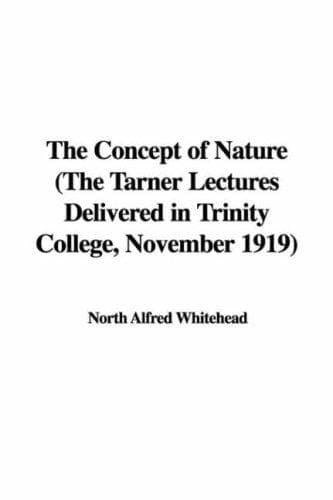
The Concept of Nature: The Tarner Lectures Delivered in Trinity College, November 1919Whitehead, Alfred North
Philosophy
The Concept of Nature: The Tarner Lectures Delivered in Trinity College, November 1919
Whitehead, Alfred North
Knowledge, Theory of; Nature; Science -- Philosophy
novelty, with the single-time series which we naturally employ for
measurement. The various time-series each measure some aspect of the
creative advance, and the whole bundle of them express all the
properties of this advance which are measurable. The reason why we have
not previously noted this difference of time-series is the very small
difference of properties between any two such series. Any observable
phenomena due to this cause depend on the square of the ratio of any
velocity entering into the observation to the velocity of light. Now
light takes about fifty minutes to get round the earth's orbit; and the
earth takes rather more than 17,531 half-hours to do the same. Hence all
the effects due to this motion are of the order of the ratio of one to
the square of 10,000. Accordingly an earth-man and a sun-man have only
neglected effects whose quantitative magnitudes all contain the factor
1/10⁸. Evidently such effects can only be noted by means of the most
refined observations. They have been observed however. Suppose we
compare two observations on the velocity of light made with the same
apparatus as we turn it through a right angle. The velocity of the earth
relatively to the sun is in one direction, the velocity of light
relatively to the ether should be the same in all directions. Hence if
space when we take the ether as at rest means the same thing as space
when we take the earth as at rest, we ought to find that the velocity of
light relatively to the earth varies according to the direction from
which it comes.
These observations on earth constitute the basic principle of the famous
experiments designed to detect the motion of the earth through the
ether. You all know that, quite unexpectedly, they gave a null result.
This is completely explained by the fact that, the space-system and the
time-system which we are using are in certain minute ways different from
the space and the time relatively to the sun or relatively to any other
body with respect to which it is moving.
All this discussion as to the nature of time and space has lifted above
our horizon a great difficulty which affects the formulation of all the
ultimate laws of physics--for example, the laws of the electromagnetic
field, and the law of gravitation. Let us take the law of gravitation
as an example. Its formulation is as follows: Two material bodies
attract each other with a force proportional to the product of their
masses and inversely proportional to the square of their distances.
In this statement the bodies are supposed to be small enough to be
treated as material particles in relation to their distances; and we
need not bother further about that minor point. The difficulty to which
I want to draw your attention is this: In the formulation of the law one
definite time and one definite space are presupposed. The two masses are
assumed to be in simultaneous positions.
Public-domain text, read in full here on John Shaqi.
Reviews
Reviews
No reviews yet
Be the first to share your thoughts on this work.
Elsewhere in the archive
Join the Discussion
Join the discussion
Sign in to leave a comment or review.
Sign InorCreate an account