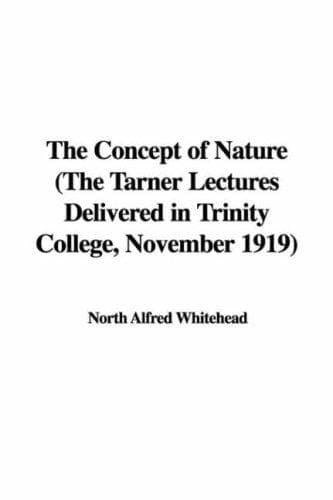
The Concept of Nature: The Tarner Lectures Delivered in Trinity College, November 1919Whitehead, Alfred North
Philosophy
The Concept of Nature: The Tarner Lectures Delivered in Trinity College, November 1919
Whitehead, Alfred North
Knowledge, Theory of; Nature; Science -- Philosophy
I have been speaking of the timeless spaces which are associated with
time-systems. These are the spaces of physical science and of any
concept of space as eternal and unchanging. But what we actually
perceive is an approximation to the instantaneous space indicated by
event-particles which lie within some moment of the time-system
associated with our awareness. The points of such an instantaneous space
are event-particles and the straight lines are rects. Let the
time-system be named α, and let the moment of time-system α to which our
quick perception of nature approximates be called M. Any straight line
r in space α is a locus of points and each point is a point-track which
is a locus of event-particles. Thus in the four-dimensional geometry of
all event-particles there is a two-dimensional locus which is the locus
of all event-particles on points lying on the straight line r. I will
call this locus of event-particles the matrix of the straight line r. A
matrix intersects any moment in a rect. Thus the matrix of r intersects
the moment M in a rect ρ. Thus ρ is the instantaneous rect in M which
occupies at the moment M the straight line r in the space of α.
Accordingly when one sees instantaneously a moving being and its path
ahead of it, what one really sees is the being at some event-particle A
lying in the rect ρ which is the apparent path on the assumption of
uniform motion. But the actual rect ρ which is a locus of
event-particles is never traversed by the being. These event-particles
are the instantaneous facts which pass with the instantaneous moment.
What is really traversed are other event-particles which at succeeding
instants occupy the same points of space α as those occupied by the
event-particles of the rect ρ. For example, we see a stretch of road and
a lorry moving along it. The instantaneously seen road is a portion of
the rect ρ--of course only an approximation to it. The lorry is the
moving object. But the road as seen is never traversed. It is thought of
as being traversed because the intrinsic characters of the later events
are in general so similar to those of the instantaneous road that we do
not trouble to discriminate. But suppose a land mine under the road has
been exploded before the lorry gets there. Then it is fairly obvious
that the lorry does not traverse what we saw at first. Suppose the lorry
is at rest in space β. Then the straight line r of space α is in the
direction of β in space α, and the rect ρ is the representative in the
moment M of the line r of space α. The direction of ρ in the
instantaneous space of the moment M is the direction of β in M, where M
is a moment of time-system α. Again the matrix of the line r of space α
will also be the matrix of some line s of space β which will be in the
direction of α in space β. Thus if the lorry halts at some point P of
space α which lies on the line r, it is now moving along the line s of
space β. This is the theory of relative motion; the common matrix is the
Public-domain text, read in full here on John Shaqi.
Reviews
Reviews
No reviews yet
Be the first to share your thoughts on this work.
Elsewhere in the archive
Join the Discussion
Join the discussion
Sign in to leave a comment or review.
Sign InorCreate an account