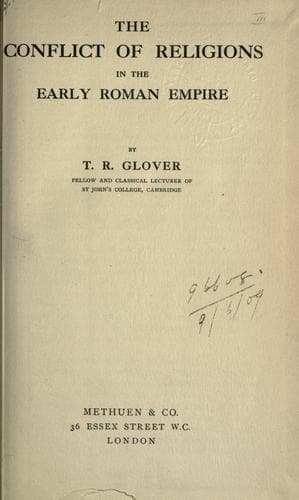
The Conflict of Religions in the Early Roman EmpireGlover, T. R. (Terrot Reaveley)
Religion
The Conflict of Religions in the Early Roman Empire
Glover, T. R. (Terrot Reaveley)
Christianity and other religions; Church history -- Primitive and early church, ca. 30-600; Rome -- Religion
reached his limits should be noticed.
The church has never forgotten the agony in the garden, but that
episode has lost some of its significance because it has not been
recognized to be one link in a chain of experience, which we must try
to reconstruct. It has been assumed that Jesus never expected to
influence the Pharisees and scribes; but this is to misinterpret the
common temper of idealists, and to miss the pain of Jesus' words when
he found his hopes of the Pharisees to be vain. Gradually, from their
pressure upon his spirit, he grew conscious of the outcome--they would
not be content with logomachies; the end might be death. Few of us
have any experience to tell us at what cost to the spirit such a
discovery is made. The common people he read easily enough and
recognized their levity. And now, in exile, as Mr Burkitt has lately
suggested,[15] he began to concentrate himself upon the twelve. It was
not till Peter, by a sudden flash of insight, grasped his
Messiahship--a character, which Jesus had realized already, though we
do not know by what process, and had for reasons of his own
concealed,--it was not till then that Jesus disclosed his belief that
he would be killed at last. From that moment we may date the falling
away of Judas, and what this man's constant presence must have meant to
Jesus, ordinary experience may suggest. Shrewd, clever and
disappointed, he must have been a chill upon his Master at all hours.
His influence upon the rest of the group must have been consciously and
increasingly antipathetic. Night by night Jesus could read in the
faces which of them had been with Judas during the day. The sour
triumph of Judas when the Son of man was told to go on to another
village after a day's journey, and the uncomfortable air of one or more
of the others, all entered into Jesus' experience; and night by night
he had to undo Judas' work. He "learnt by what he suffered" from the
man's tone and look that there would be desertion, perhaps betrayal.
The daily suffering involved in trying to recapture the man, in going
to seek the lost sheep in the wilderness of bitterness, may be {129}
imagined. Side by side, King, Pharisee and disciple are against him,
and the tension, heightened by the uncertainty as to the how, when and
where of the issue must have been great. Luke's graphic word says his
face was "set" for Jerusalem--it would be, he knew, a focus for the
growing forces of hatred.
Public-domain text, read in full here on John Shaqi.
Reviews
Reviews
No reviews yet
Be the first to share your thoughts on this work.
Elsewhere in the archive
Join the Discussion
Join the discussion
Sign in to leave a comment or review.
Sign InorCreate an account