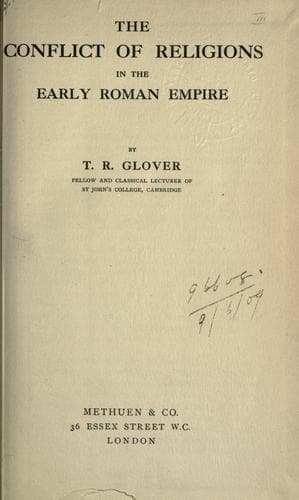
The Conflict of Religions in the Early Roman EmpireGlover, T. R. (Terrot Reaveley)
Religion
The Conflict of Religions in the Early Roman Empire
Glover, T. R. (Terrot Reaveley)
Christianity and other religions; Church history -- Primitive and early church, ca. 30-600; Rome -- Religion
Into all these great divisions of the world came men eager to tell
"good news"--generally quite commonplace and unimportant people with a
"treasure in earthen vessels." Their message they put in various ways,
with the aphasia of ill-educated men, who have something to tell that
is far too big for any words at their command. It was made out at last
that they meant a new relation to God in virtue of Jesus Christ. From
a philosophic point of view they talked "foolishness," and they lapsed
now and then, under the pressure of what was within them, into
inarticulate and unintelligible talk, from which they might emerge into
utterance quite beyond their ordinary range. Such symptoms were
familiar enough, but these people were not like the usual exponents of
"theolepsy" and "enthusiasm." They were astonishingly upright, pure
and honest; they were serious; and they had in themselves inexplicable
reserves of moral force and a happiness far beyond anything that the
world knew. They were men transfigured, as they owned. Some would
confess to wasted and evil lives, but something had happened,[2] which
they connected with Jesus or a holy spirit, but everything in the long
run turned upon Jesus.
Clearer heads came about them, and then, as they put it, the holy
spirit fell upon them also. These men of education and ideas were
"converted," and began at once to analyse their experience, using
naturally the language with which they were familiar. It was these men
who gave the tone to the groups of believers in their various regions,
and that tone varied with the colour of thought in which the more
reflective converts had grown up. A great deal, of course, was common
to all regions of the world,--the new story and the new experience, an
unphilosophized group of facts, which now, under the stimulus of man's
unconquerable habit of speculation, began to be interpreted {143} and
to be related in all sorts of ways to the general experience of men.
No wonder there was diversity. It took centuries to achieve a uniform
account of the Christian faith.
The unity of the early church lay in the reconciliation with God, in
the holy spirit, and Jesus Christ,--a unity soon felt and treasured.
"There is one body and one spirit, even as ye are called in one hope of
your calling; one Lord, one faith, one baptism, one God and Father of
all, who is above all and through all and in you all."[3] The whole
body of Christians was conscious of its unity, of its distinctness and
its separation. It was a "peculiar people"[4]--God's own; a "third
race," as the heathen said.[5]
[Sidenote: The recruits]
To go further into detail we may consider the recruits and their
experience, their explanations of this experience, and the new life in
the world.
Public-domain text, read in full here on John Shaqi.
Reviews
Reviews
No reviews yet
Be the first to share your thoughts on this work.
Elsewhere in the archive
Join the Discussion
Join the discussion
Sign in to leave a comment or review.
Sign InorCreate an account